Friday, February 26, 2016

Embracing Strength Training


Speaking of biases.  For years when I passed by the weight-lifting gym on my way to a spin class or the pool I would glance over at the weight-lifters with a sense of superiority.  All these narcisstic guys in their muscle shirts and belts prancing around for hours staring at themselves in the wall-to-wall mirrors and occasionally straining to hoist some big weight.  I would congratulate myself on how I am meanwhile engaged in my much healthier sport of triathlon -- preparing for a great competitive endeavor with my triathlete community in the great outdoors.  

Being as scrawny and weak as I am though, perhaps I am just envious? And in any case my lack of strength seems to be my key limitation in triathlon. So this month I resolved to overcome my bias and embrace the sport of weightlifting  (at least for the off-season) especially given that: 


1. I increasingly hear that strength work is just as important (some argue MORE important!) than the triathlon type cardio/aerobic training for overall health (especially as you get older) 


 2. Like so many millions of people, I have been stressed over the thought that I am paying so darn much for my overpriced fitness club every month, and I am not adequately utilizing it


3. I crave quantifiable progress. With running and swimming it has been soooo hard to break out of my plateau - I long for the instant gratification of tangible improvement 


So my idea is to create more of a a sense of purpose around weight-training - instead of only half-heartedly going through the dreary motions of lifting -- I will try to lift a bit more every few weeks.  Like the Greek legend, Milo of Croton starting out with his newborn calf and lifting it everyday until he is lifting a full-grown bull.  Not that I am necessarily so concerned about being able to lift a bull.  Over 3-months of 3x per week progressive overload I just hope I can achieve some measurable improvement.  Perhaps it will benefit my running and triathlon performance.  Perhaps not.  Regardless, I embarked on my program a few weeks ago with a piece of notebook paper to jot my results and with great enthusiasm.   


And so far it is working!  For example with dips I add 1 more each session.  10 days ago I absolutely collapsed off the bars after 11, but then two days later I could do 12 before I collapsed.  Then 13.  Yesterday I did 16! 

It is so satisfying.  It seems the physiological benefit of progressive stress adaptation gets combined with the mental focus and confidence of doing just one more rep each session.  

It is like training for a half-marathon for me in earlier times before the plateau - every Sunday just add one more mile at like like 5:30 per mile. 


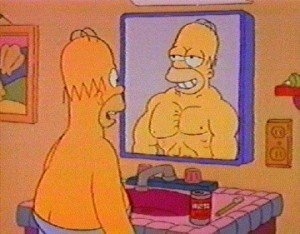
And I can admire myself in the wall-to-wall mirror 


Friday, February 12, 2016

High intensity intervals vs Longer, slow, steady runs


After my last post I have been told that I am living in a high-intensity-interval “echo chamber.” In other words, I am like a climate change denier who only seeks out articles arguing that climate change is not occurring, and becomes caught in an "echo chamber" continuously being only fed yet more such articles by social media, search and his circle of friends, and where competing views are screened out.  I am only reading that high-intensity is beneficial, and long-slow marathon training is somehow “old-school” and “ineffectual” and more likely to lead to burnout and over-use injury (see my last post below).  Moreover, when I lead my weekly high-intensity hill repeats or run Wednesday intervals and ask this self-selected group of participants, they all heartily agree that sprinting up a hill at a crazed level of exertion is the ultimate healthy activity.  


Maybe there is a whole world of evidence that sticking to 100% longer, easier, aerobic runs is optimal?   Longer, steady-state runs seem to be what most of my marathon-focused teammates do almost exclusively, most all the time. Maybe they know something I don't?      


So in my effort to break out of my narrow, close-minded gated community, I find another computer, log-in with a different name and seek articles on the merit of longer, steady exercise.  My search delivers an odd assortment of viewpoints --


My quick reaction - 

1. Wow - there are people that do ONLY high intensity training?
Apparently there is this whole world of sedentary Americans whose only exercise is Crossfit and intense treadmill workouts.  My heart cries out - I feel such sympathy for them.  

2. For runners just 10-20% high intensity seems more appropriate 

3. My triathlete teammates scoff at this idea of long, aerobic base training as "just so 1970s" favoring "reverse periodization"

4. Importance of seasonality - Yeah, yeah, yeah,  see  my "off season" post among others below

5. Reading all these long paeans to the spiritual joy of really really long runs is even more boring than really really long runs

6. Ultimately my effort to be open-minded is an abysmal failure.  Alas, the most compelling data point I stumbled across was this article which largely supports my prevailing view (bias).  The US Military(!) -- that same institution that produced the original 1960s era data on the health benefits of long running — has decided to increase the intensity of their troop’s training and reduce the volume of running based on extensive evidence of over-use injuries and troop performance.


Thursday, January 28, 2016

No Race For Old Men

I have been increasingly an advocate for shorter distance racing and training.  High intensity is better as we get older I keep reading.  All the rock star over-50 runners at Seattle’s Club Northwest focus on 5k and cross country and they have been absolutely thriving - blasting through 5k under 18, even 17 minutes as they pass the 50-year, even 60-year mark.   And the guys I remember from the Seattle running scene from years ago who did lots of marathons? I don’t see their names on any race finisher lists any more, or even hear about them running at all - I imagine them shuffling around a nursing home unable to bend down and tie their own shoes after all the damage to their legs from the marathon training.  I have come to see intense training as the fountain of youth. 

So Sunday's Shibuya Ekiden (Relay) should be perfect for my program to maintain this vitality — a lung-searing 2.9 kilometer sprint around a tight park course.  

In past years (see these posts from 2014 and 2015), I achieved great  glory in the over-40 age group relay team.

But this year I find myself the anchor runner on my team's open division A team - I am a last-second substitute on this team of young, fast runners.  When the 3rd runner hands me the sash our team is hanging onto 3rd place and poised for another glorious place on the podium.  I tell myself to give it everything and hold off the other runners - I essentially need to just run the kind-of two mile time I could easily do when I first started running years ago, the kind of speed an average high school kid can do.   I manage to hold onto 3rd for the first kilometer, but then a lithe college aged runner glides me like I am not moving.  Around the hallway point another college kid passes me, and then another. And then yet another.  I see my teammates along the race course exhorting me to somehow speed up and hold off the college aged competition as I lumber along, but I simply don't have the speed to summon. Finally I stagger across the finish line in 7th place.  


Here is a picture of me at the finish line looking shell-shocked. I am remembering why athletes turn to longer races as they get older, and I ponder if I should have acted my age and joined my aged teammates doing a half-marathon that same morning in Chiba.   


Tuesday, January 12, 2016

Run Training Summary

All three of the 10k races this fall have been slightly off my desired competitive level - a 37:20 at Bbq Run, a 37:15 on slightly shorter but hilly Run for Cure, and a 39:09 at Chiang Mai 10.6k (which I am generously adjusting to 37 minutes flat for 10k).  

Why?  As you can see in my Run Mileage Chart below, my running had fallen off during the summer triathlon season


Quantity fell off more than quality as this graph suggests (and I am more of a proponent of quality). But quality was also compromised by all the tiring swim and spin sessions. 

But in recent weeks, as you can see, run training volume is up.  Given my experience in recent years that would suggest that I will be in great running shape by around April or May.  Unfortunately by that time I will be well into triathlon season, and there are few run races anyway.

Saturday, December 26, 2015

2015 Chiang Mai 10.6k

I return to Chiang Mai, the wonderfully affordable holiday destination, in hopes of achieving further glory at the Chiang Mai Marathon events.
  
I had placed first overall in the half-marathon four years ago, back when the event was a small, homey affair, and we chatted with the race director and got to know many of the other runners, and practically our only spectators at the sunrise event were some ladyboys heading home after working at the bars all night.  Now the Chiang Mai event has grown into a regional economic juggernaut with over 7,000 participants coming from all over the world, hundreds of volunteers, costumed dancers and musicians, and the entire city festooned with garish banners welcoming the runners and sound trucks crawling through the city streets blaring out announcements for the race. I had watched the first “Hunger Games” movie on the flight over, and all this new powerful, Chiang Mai Marathon event build-up and pageantry reminded me of the spectacle built up around the hunger games contest in the dystopian movie.  

I join over 2,000 other runners in the 10.6-kilometer event (there are 4 races starting one hour apart).  We start the race to an explosion of cannons shooting smoke into the air, rows of musicians beating on drums, and the city's top celebrities and political officials cheering us on.  I start on the front line which appears to have been a mistake as runners burst past me and I am nearly knocked off my feet by a guy in an orange singlet sprinting at absolutely full speed.
I stay behind Arnaud, and at 1k which we apparently ran in 3:53, there are at least 20 guys ahead of us and I wonder whether it was cocky of me to have expected to be on the podium at all – even just for my age group. 

At the starting line we had identified other runners in our age group based on their race numbers including a local 50-59 year old Thai clad in clunky red generic shoes and cheap cotton shorts, who had warmly wished me well in the race. He did not look like a particularly elite athlete – I understood him to say that he was a worker in a rice farming village to the south of Chiang Mai.  But this age-group rival burst quickly out at the start, and I knew he must be in the large pack ahead of me, a pack that seemed to be pulling further and further ahead. So I reluctantly surged past Arnaud and begin picking off the other runners one by one. By 3k I spotted the heavy red shoes of my local Thai age-group competitor and I settled in behind him for awhile. When I had gather enough strength to sprint past him he valiantly tried to stay with me, but after his fast start was laboring and eventually dropped off.

Ultimately I managed to move all the way up to 4th position almost catching the guy in the orange singlet who had almost knocked me down at the start and who apologized profusely when he turned and saw me cross the finish line.

Naturally there are lavish awards to the victors in this epic tournament.  Here you can see me being awarded with an extravagant 3,000 baht first-place cash prize – an enormous amount of money in low-cost northern Thailand.

My rival in the bulky red shoes is gracious and magnanimous in the face of his crushing defeat afterwards. I feel almost bad to have denied him victory, presuming he would make better use of the huge prize winning.  I ponder settling in Chiang Mai myself and living off the prize money.   

Instead I somehow managed to squander every last cent of my precious winnings within the next day, frivolously blowing it all on over-priced, airport pastries and cappuccinos, useless plasticky Christmas trinkets, and ephemeral, online text stickers...

Saturday, November 14, 2015

My "off-season" - 4 random races over 5 short weeks

I felt exhausted after my effort at the Korea Half-Ironman.  Korea was my end-of-season “A” race.  According to most any authority on endurance training, this past month should really have been my “off-season”-- a time when I primarily rest along with some strength work and perhaps spend some time on my various minor technique weaknesses (my swim kick, my bike cornering, quickly removing my wetsuit…) 

But no, no, no – I have an odd assortment of events on my calendar: FOUR completely different competitive endeavors over the five weekends following October 4th:


1.     Shimoda Triathlon 4 / October 11 – I can’t miss the social event of the season – the 4th informal Shimoda Triathlon.  I enjoy my strongest swim in 2 years in the stormy Shimoda cove, but the fact that it pours down rain during the bike effectively ends my competitive effort halfway through the bike.  I just try not to crash on the scary steep downhill sections amidst the total deluge. 


2.     Inage Aquathlon / October 17 – I have long wanted to do an Aquathlon – a two-stage run/swim race - and I could not pass up the opportunity to join a half-dozen teammates for this 1.5k swim and 10k run.  I really was curious to experience running immediately after the swim and address the question of how strong of run I could do coming off the swim, versus coming off the bike.  The answer: not very strong at all.  I have always been dazed at start of bike in triathlon.  On the bike I could coast.  On the run at Inage I was just suffering – struggling to do 4-minute pace (ouch).  Still I mange to win my age group in time of 1:14:14.


3.     Pacific Northwest Cross Country Championship / November 1 – Hey, why not jump in the local cross country championship in my continuing pursuit of varied events?   Of course I was very much out of my element.. All (and I mean all) the other guys on the Club Northwest team seem totally (and I mean totally) focused on cross country – “I have been doing dedicated cross country workouts since mid-summer” one of the guys tells me – “these are far and away our most important races of the year”.  I have done zero dedicated cross country workouts this year (along with this one last year).   None of the athletes I know in California, Tokyo, Singapore, etc. ever talk about cross country (bar a few hard-core British runners).  I am asked if I will wear spikes in the race. Spikes?  I haven’t worn spike in decades. I haven’t even remotely considered wearing spikes in decades.
So I guess it was understandable that I floundered on the steep, slippery half of the course, but I would like to do better in this type of event.  What was particularly disconcerting to me was that even when I got to the hard-packed trail portion of the course I was still way off my recent race pace.  My pace for the 6k course?  3:59 per kilometer (again - ouch)  28th place out of 64 guys.  


4.     Barbeque 10k / November 8 – I am there for the barbeque (and opportunity for a pure running event).   

I run 37:20. 

 Compare to last year’s 36:59 when my training had been more concentrated on running.  Felt surprisingly good at the start of the race, but my energy fades over the 10k.  (Only 10k - how can I fade?!  Apparently the lower running mileage 30k-40k per week this year versus 50k-70k last year?  or the lack of race-specific training?) 

Thursday, October 08, 2015

Qualified for World Half-Ironman Triathlon Championships


I make the podium at the Korea Half-Ironman triathlon on Sunday finishing in second place among the 44 entrants in my age group.


As you can see I am happy to make podium in a triathlon (one thing for me to make the podium in a run event, but triathlon has been a bit more challenging/competitive)


My time of 5:11:37 falls short of my dream of breaking 5 hours, but it is my PB for the distance by 6 minutes: 

Swim -   43:37
Bike -  2:42:52
Run -  1:39:19
T1&2 -   5:47 
Total -  5:11:37

Swim- My swim felt strong, but when I look at my watch at the end, I am a bit dismayed to see that I am still swimming way slower than the pace I consistently raced at several years ago (even slower than the splits at my two Ironman distance races – both splits at Frankfurt where I swam a 1:16 in a wetsuit with a broken zipper).  I have done far more quality swim training sessions in 2015 than any other year.  The more swim training I do, the slower it seems that I swim. 


Bike - I don’t really allow myself to worry about my slow swim though as I stagger into T1. I tell myself that a slow swim is not fatal to my overall race time goals given the relatively small weight of the swim in a half-ironman triathlon, and I manage to turn my attention to consuming gels and powering up to race pace on the bike.  


I also manage pay some attention to the picturesque mountain setting - Gurye is nestled in a mountains of south, central Korea –an ideal venue for a half-ironman with the flat river plain. 


I averaged 33km/hour on the relatively flat, fast bike course – my strength ebbing slightly over the last 20k or so. It was during these last 20k thatI caught my mates Henrik and (amazingly) David who I presumed was far, far ahead of me, but was having an off day.  It really helped to have the teammates to pull me along.  My shortage this year of long bike training sessions was starting to make an impact.  This lack of training did not seem to have actually affected my race performance yet – though it would take a toll on the run. 


Run - I chatted with David in the transition tent, and when I passed him at the start of the run he shouted encouragement at me to break 5-hours.  Breaking 5-hours would entail running an extraordinary pace for me given how trashed my legs felt from the bike. But I told myself that I felt strong, I would give it everything I had or die trying, and soon I was actually running close to 4-minutes per kilometer pace.  Amazingly all the way through the first lap of the 2-loop run I managed to maintain this suicidal pace. 


But when we started the second lap things deteriorated. From 12k to 16k was just a bad, bad period. I hear other endurance athletes talk about being masochistic – enjoying the pain somehow.  Well, I would prefer to minimize the amount of time I spend at the level of misery I felt during that section of the run.  After walking through the aid station at the turnaround at 16k and starting to head back toward the finish line I managed to regain strength and achieve a better mindset and focus on “form under duress”.  


I felt pretty satisfied with my effort as I crossed the finish line and the medical staff dragged me to the massage tent and I thought about how my hard triathlon training was finally over.  And I’d vanquished the ghosts from my debacle in the Taiwan half-ironman. 


Oh.  And I qualified for the World Championships. 

Making it to the Worlds had been something of a goal for me to justify the training and feel like a real triathlete again. But spots in the half-ironman championships next September in Australia have become increasingly coveted.   
I was ready with my credit card in case I did qualify. Yes, they charge you for the entry fee and even expect you to pay right on the spot.  People have asked me if I received any prize money or cool stuff like in running events..  No, no, no – remember triathlon is targeted at an upscale demographic market segment.   Basically in triathlon if you place well you just earn the privilege of registering for even more wildly expensive events.  
Actually tho the registration did include this dorky hat and this really keen combination bottle-opener/keychain 


Monday, August 10, 2015

HIIT and the Social Athlete

The NYTimes published a series of articles last year extolling the virtues of High Intensity Interval Training (HIIT).   High Intensity training is simply a series of very short burst of exercise at near maximum effort followed by recovery. The training concept has long been utilized among endurance athletes (Sebastian Coe doing wildly fast 200-meter repeats, the Tabata Protocol workouts, etc) with more rapid and efficient improvement in aerobic capacity and racing performance versus steady-state workouts.  More recently there has been various research suggesting metabolic benefits - fat-burning, insulin resistance, long-term cardiovascular benefits, neurological benefits, and more - hence the NYTimes articles urging even the most sedentary types to take on a regiment of painfully intense sprints on stationary bikes, rowing machines, boot-camp calisthenics, etc. 
  

 I seem to have inadvertently become something of an evangelist for this High Intensity Training myself. Saturday after Saturday I find myself leading a group repeatedly sprinting up  a series of nearby hills.  I had started these sessions some 20 months ago with two other runners as a brief off-season strength building effort.  These two teammates are long gone.  But, much to my surprise -- my extraordinary surprise -- the painful Hill Repeats have lived on.   

I thought perhaps everyone else had been reading the NYTimes Wellness columns.  Why else would they subject themselves to hill repeats?   But the other participants look at me blankly when I asked them if they are joining the workout because of the metabolic benefits..

After reading all these articles I had started to assume that everyone must be on the HIIT bandwagon, however when I look around at pool or gym, 90% of other people exercising are just plodding along at a steady pace.  Even  in my spin class, many of the participants hardly follow the instructors urging them to sprint and to climb.   I can certainly understand why most people prefer a long, easier steady workout -- I envy the blissed out swimmers gliding serenely through water while I am bent over the edge of pool gasping for breath.  I much prefer just being lost in thought on run through forests and not being a slave to my watch.  So I was not surprised last week the NYT comes out with a story about Danish researchers who are shocked, shocked!, that not every middle-aged, overweight, sedentary person has embraced a  intense, painful interval regime

The Danish researchers go on to contrive a formulaic workout which they argue will make high-intensity training appealing to the masses.   But my own experience with Saturday Hill Repeats makes me wonder if turning a challenging exercise program into a habit is so much a function of the specific workout structure.  The Hill Repeats benefit more from the fact it works for all speeds with the fastest runners turning around and uniting with the slower runners as they jog back down the hill after each hill repeat (in contrast to say a long, fast group bicycle ride where all but the fastest cyclists ride in constant fear of being dropped and then struggling on their own for the remainder of the ride, perhaps becoming hopelessly lost on some distant mountain course).  The Hill Repeat dynamic is similar to what has made the Hash House Harriers surprisingly popular with its weird, convoluted system of a hare setting up a false course so the fastest runners would intentionally get lost and backtrack to the slower runners.  
 
Moreover, the Saturday Hill Repeats team is very diligent about Social Media. We seem to always take time for the all-important photo ops.

Not to mention the critical post-workout reward and camaraderie with Starbucks and museum visits and global brunch experiences after each workout


Tuesday, June 30, 2015

Shimoda Triathlon 3

I compete in the 3rd Shimoda Triathlon last weekend

I am forced to borrow a bike after my triathlon bike is slightly damaged during shipment back from Hiroshima.

The borrowed bike is agonizingly slow and heavy and on the downhill it feels like I am trailing a parachute behind me. 
I imagine a serious cyclist/triathlete with their thousands upon thousands of dollars of bike gear and fetish for having fastest technology would be outraged about suffering the pain and  indignity of using slower equipment.  As for me, I was bummed to not experience the glorious 40k per hour speed on flat like at Miyajima Triathlon, yet when I consider the results over the 37-kilometer Shimoda course, the slower bike does not seem drastically significant.   Thanks to drafting and some long uphill sections I am able to move up from 8th place to 5th place during the bike segment. 


In fact once again it is my slow swim time that has the bigger impact on my race.  It takes 24 minutes to swim some 1000 meters.  I have been doing considerable swim training this spring with lots of focus on strength and form.  But I am not getting any faster.  My results are getting slower.


Not that the results matter that much on Sunday - it is a fine, scenic weekend with friends.  And anyway I finish 2nd - way, way too far from 1st place to even trifle over whether one component would have made a difference.


Saturday, June 20, 2015

Miyajima Triathlon


In a continuing effort to experience more novel and unique endurance events I travel to Hiroshima last weekend to participate in the Miyajima "Woodman"Triathlon. 

Miyajima boasts perhaps the most spectacular swim start of any triathlon in the world (well perhaps second to the notorious Escape from Alcatraz) --the Miyajima Island World Heritage Site and its iconic floating torii gates. 


We were ferried out to the island at sunrise where we  change into our wetsuits and prepare for the swim in a 500-year old wooden shrine.


Then we proceed through the orange corridors of the main Itsukushima shrine where all the athletes stop to pray (in my case praying to survive the swim which preoccupied me at that moment, though in retrospect I should have prayed for more strength coming off the bike and onto the run).  


The island is overrun with deer who aren't at all skittish about creatures in wetsuits


The swim was surprisingly pleasant with the mass start of 500 age group swimmers spread out over a wide course, and the straight, point-to-point nature of the event eliminating the congested turns around buoys. 


I was a bit off-course with my tendency to drift right – as you can see in my swim path here (in grey)  vs Keren's more direct route (in red): 


I have lost count of how many times Keren has told me since the race just how terribly slow my swim split was at 48:42  for 2.5k.  But I was reasonably pleased with it given how much I've struggled recently to do 100s in the pool on a 2:15 cycle, and having not been out in open water at all this year. 

I came out of the water in 222nd place and started moving past people on the bike's early short uphill sections.  I had read and heard the warnings about the long, steep switchbacks on hill #4  toward middle of the bike section and hill #7 toward the end.  The hills were definitely challenging –   but I felt surprisingly strong and the crowds of spectators and drummers toward the top of these hills helped.  

Admittedly I struggled on the final 2k descent with young girls rocketing past me -- my arms felt bizarrely tired and I just  focused on not crashing on the tight corners.    Still by the time I finished the bike I had overtaken 134 competitors to move up to 88th overall with a bike in time of 2:21:27.

The long hill on the run I had also been warned about, and in contrast to the bike hills the climb on the run proved far worse than I anticipated. By 11k I feared that my run time was going to be a disaster, but thankfully  much of the last half of the run is downhill and I was able to regain my form and some strength and finish the race in around 4:51, good for 5th place.  I was told that Woodman is somewhat equivalent to a half-ironman distance race, and 4:51 is far faster than my previous efforts at that distance. 

So it was certainly worth the extra effort to journey to a unique, new endurance event.   Apart from about 50-minutes of sheer, unsurpassable, torturous misery during the middle 8k or so of the run, I was smiling and enjoying most of the triathlon. 

Moreover, the triathlon was a good excuse for visiting the Hiroshima area.  Keren and I flew down to Hiroshima on Friday morning on the new Spring Airline low cost carrier (only 7,000 yen each way though you have to travel via the notorious new Narita Terminal 3), and I shipped pretty much everything but a small daypack to our weekend hotel, so there was none of the usual effort to lug bikes and wetsuits and gear.

This facilitated our fine tourist experience  visiting the obligatory and sobering Atomic Bomb Museum and Park, sampling the Hiroshima-style IPAs at the craft beer pubs, swimming at the Hiroshima-style public swimming pool, lounging at the European-style cafes along the river filled entirely with Australians, and  eating Hiroshima-style okanomiyaki at Okanomiyaki Village, a building filled with floor after floor dedicated entirely to mom-and-pop okanomiyaki stalls.