Monday, August 27, 2018

Cebu Half-Ironman

I dreaded the Cebu Triathlon.  I dreaded every aspect of it.  I dreaded swimming in choppy seas. Biking on a narrow, crowded course.  Running in mid-day tropical heat.  I dreaded the thought of all the travel and costs and logistics.


As usual in life and triathlon -- it all turned out well - I survived - I did not drown or crash or suffer heat-stroke -- I even managed 6th out of 41 in my age group, 243rd overall (out of 
some 2500 entrants), and enjoyed a memorable excursion to Cebu with a fun group of teammates.
  
Not that my fears were entirely groundless -- 

``
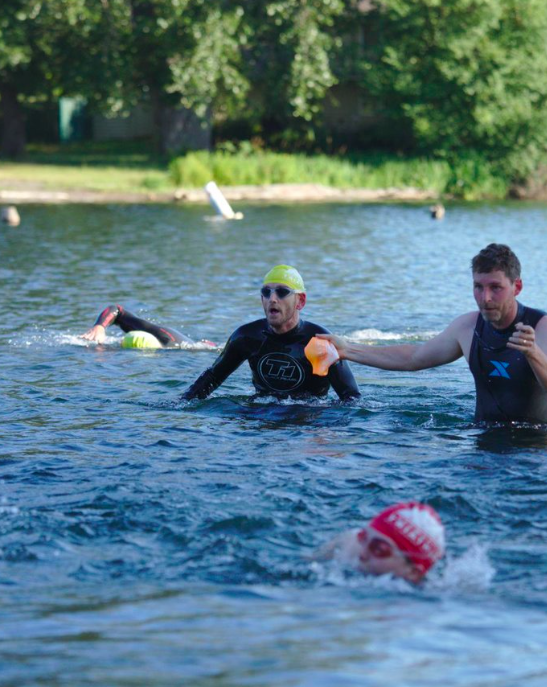
In fact the swim was choppy.  The rolling start was smooth enough, but when I rounded the second buoy and turned into the waves and the current I started to panic. I didn’t help that the swells pushed a slower earlier wave swimmer into me while 3 faster swimmers from later wave swam over me.  But I reminded myself that I have done this many times before, and powered through the rest of swim, staying focused on each stroke.   While my swim time of 47:16 minutes to cover 1.9k is a shockingly long time in the water, it was still among top half of finishers.   


And the bike ride did seem treacherous - at least at first when a dog ran across my path (reminding me of a childhood mishap), and countless riders burst past me (often then slowing down).   Training primarily on an indoor trainer (if at all) means that once again I am not terribly aggressive starting the bike, though I did find myself passing a lot of riders on the later laps.  The huge screaming crowd lining the course encouraged me.   While m
y time of 2:58:33 was slower than my other half-ironman efforts is as good as I might expect.  

And the run was hot.  A blazing sun burned through the clouds just in time for the mostly shade-less, mid-day half-marathon.  So I took walk breaks.  Numerous proactive, carefully timed walk breaks - roughly every two minutes.  I took leisurely strolls through every single aid station luxuriating in the feeling of squeezing the ice cold sponges over me and drinking cup after cup of sports drink or ice water.  When I actually did break out into a run I was reasonably strong - my time of 1:46:44 was OK (fastest in the age group).

Total time: 5:40:39


Cebu was my longest and "biggest" race of 2018.  By "biggest" I mean most talked about, most expensive, most anticipated and entailing the most travel.  But by "biggest" I don't necessarily even imply that it was my "A race"  -- the race that the well-coached endurance athlete would structure their training around.  Normally a triathlete's longest race will also be their A race -- it works best that way with tapering and recovery.  But my training leading up to Cebu included a lot of obstacle course drills and my key weekly workouts continued to mostly be shorter faster run intervals, just like the rest of the year.   At least I did manage some long, enjoyable bike rides in the mountains this summer with the TiT group, so it is certainly not the case that I went into the half-ironman "cold"  

Sunday, July 29, 2018

Lake Whatcom Triathlon


I need to do a couple triathlons each year to force myself to swim and bike a bit. So for 2018 I enter the lovely  Lake Whatcom Triathlon in Bellingham, Washington
(plus next week's dreaded Cebu Triathlon)


Lake Whatcom is a friendly, scenic local event.  The event is only in its second year and a couple hundred triathletes participated.  The locals are concerned about the 70 degree temperatures, but I found the weather cool and crisp and the Pacific Northwest lake is clean and refreshing  


My time for the Olympic Distance event is acceptable:


Swim -    28:38 --  105th - Nice improvement over my recent triathlons 
Bike -   1:18:48  -   50th - Slower time on reasonably fast course 
Run -       44:36  -  14th -  Faster time on slow course (winding trail with stairs) 


Transition 1 consumes a startling and amusing 4 minutes as I struggled endlessly to tug my wetsuit over my timing chip ankle strap.  I find myself with time for a long, philosophical discussion with the lackadaisical triathlete next to me at the bike rack covering topics ranging from existentialism  to how our transition time is going to look on the  results breakdown (we weren't the very slowest athletes in T1, but very close).


My bike time was significantly slower than my Olympic races a few years ago.  Most guys would point to fact of using their "B bike" and obsess over the extra ounces of bike weight.  I was more concerned over the lack of bike training again this summer, as well as not having any fast guys around me after starting in the last wave and being a slower swimmer.

Nonetheless this was one of my rare opportunities on a bike over the past couple years so I try to push a big gear and overtake people as best I can.


I seem to have dropped a notch in terms of competitive drive on the run - at least relative to the suffering I have pushed myself to experience on previous triathlon runs.  At Lake Whatcom, I felt pretty light and comfortable scampering around shaded trails that twisted over stone bridges and up and down hills and stairs in a gorgeous, old city park.  


Despite all my various issues and excuses, the effort is good enough for me to end up on the podium 

I finish 2nd place yet again (see my last 3 or 4 race reports to read about other 2nd place finishes) -- and again it is not an issue of being out-kicked by the winner.  This guy in my age group who finished ahead of me blasted through the short swim a startling 10 minutes ahead of me and I didn't manage to make up any ground on him the rest of the event.  

Friday, May 25, 2018

Living in the Present (May Race Reports)

On May 13th I run 38:41 at the Fuji-Susono 10k, bettering my time from a year ago by over 30 seconds, and even improving on my time from 2-years ago by 6 seconds. 

A 6 second improvement may not sound like much, but I am encouraged just to be running at the same level as in 2016, after 19 months of compromised training and races.  

I figure that on a flatter course this effort would be roughly a couple minutes faster – 3 minute adjustment on the 4k of climbing offset by the minute or so I gained on the downhill.  

And yesterday I run 17:48 at a 5k time trial on the track. The organizers provided pacers a minute apart, and I chose to stay with the18-minute pace guy.  I diligently stayed right behind the pace guy every step until the final lap when I suddenly found the strength to run a 74 second 400 meters.   


As far as I am concerned at this point, I set my “Personal Bests” this month.  I deem these times my "personal bests” since they are my best races in the last 2 years.  

Anything prior to May 2016 is not worth thinking about.  I am trying to live in the present. Early 2016 is long lost and forgotten back in the distant mists of time.  Moreover from a philosophical perspective the person that competed in those events back in 2015, 2014 and earlier has less and less connection to my current self and has begun to seem like a different person altogether.  

 At my advanced age it becomes discouraging if I dwell on times from the distant past. 


I managed to win this keen silver medal too


Thursday, April 26, 2018

3 + 2 Training (FIRST) & April Training Summary


It is April - time to start triathlon training, and my whole
80/20 training program I talked about last month is out the window.

Now I am a FIRST 3+2 runner.

"FIRST 3+2" means three quality weekly run workouts plus "cross-training" sessions.

There is a whole book on this program too -

People feel remarkably passionate about these variations in training programs - check out this coach vilifying the FIRST program (I am endlessly fascinated that people can get so worked up about variations in endurance training). 

I suppose FIRST is not optimal for most people, but for a "Runner with a cross-training problem" as a triathlon teammate once called me, the FIRST method appears to be something of a fit. I mean if there is ANYONE on the planet that is good candidate for the RUN LESS / RUN FASTER program it is me --
- I am a triathlete focusing mostly on running races
- I have experienced more injury problems from increasing mileage than increasing speed
- I have developed efficiency after years of running
- I get bored doing too much volume training

I still cannot really reconcile the 80/20 running with any of the triathlon programs I have tried to follow-- as I have complained about in  All Intensity, All the Time post -- ALL the real triathlon workouts are intense for me, with the only aerobic training being warm-ups and cool-downs.


So here is a snapshot of my APRIL running with roughly 3-4 quality runs per week -- the long runs always included speed toward the end of the session, and most of my Tuesday runs included some bounding drills.  Notably I am  back down to only around 40 kilometers per week of running:


And here is the snapshot of the same training month with all the swim and bike training sessions included (in blue and lavender bubbles):


For the most part my body feels better on this program.

Tuesday, March 27, 2018

80/20 rule -- 80% easy / 20% intensity (and February/March training summary)


One of my teammates asks me if I really think that the easy runs are essentially "worthless", and that we should just focus on quality training and drills such as the bounding that I had mentioned in the earlier post.  

I tell him that my sense is that training follows the 80/20 rule - intensity (speed, quality) should be no more than 20% of weekly mileage and the other 80% should be at an easier conversational pace.  Moreover I have felt that 80% of my training benefit comes from the 20% quality sessions - and so the easy runs are not "worthless" - just generating less benefit for the time spent.  

I was under the vague impression that I had come upon this keen insight myself,  but then I googled "80/20 endurance training" and it turns out there are whole books on this subject --

I check out a digital copy of 80/20 Running from the Mukilteo Library, skim through it, and learn about the copious research going back to Arthur Lydiard suggesting that this 80/20 training ratio is the optimal formula for improved race performance. The book's author, Matt Fitzgerald, is much more fervent than I have been regarding the benefits of slower runs for depleting glycogen, releasing IL-6 and building cognitive strength.  I have been focused mostly on run training over the past year or so and ask myself whether given my prioritization of group camaraderie, racing frequently and enjoying scenic routes am I at all close to this magic ratio.

Granted, as noted in previous blog post, I have always been the most "polarized of runners" - in fact a coach had pointed to me as an example of extremely polarized training, pointing to all my markedly slow 6 or 7-minute per kilometer sessions posted on Strava juxtaposed with my intense hill repeats and track intervals at a pace bordering on race speed.  

Given my low mileage along with fact that I have been doing all those bounding drills and adding speed at end of a weekly longer run in recent months I wonder if I have started doing too much speed?

So here is a snapshot of my recent training --


 The yellow and dark green bubbles of “intensity” above entail:

- my customary mid-week track intervals - roughly 6k of intensity
- hill repeats (incorporating bounding and sprint) - roughly 2k of intensity
- longer run pick-up pace on about the final 25%  - roughly 4k of moderate intensity

So (taking into account warm-up and cool-down), I am pleased to see that at least for the moment I seem to be hitting this golden ratio, doing 12k of actual intense running out of about 55k of weekly mileage or 22%


Friday, March 02, 2018

The Frugal Triathlete


My payment software generates slick and detailed output (note that I used to work for this financial software company back in Silicon Valley), and I feel compelled to put my triathlon and running costs in US$ into this keen Sankey flow diagram:    


The main observation is that 2017 was a remarkably low budget year — a few years ago when I did an ironman I am sure that I spent at least three times this amount due to the expensive race entry fees, lots of coached group swims, and peer pressure to invest in pricy bike components.  In 2017 I only competed in two relatively smaller and less expensive triathlons in the US. 

The other observation is that running shoes are increasingly expensive as noted in an earlier post despite buying several pairs at half-price and getting a free pair from Brooks.   

Running is supposed to be such a natural, low-cost activity relative to cycling or swimming.. or golf or skiing or sailing.  (Though for lots of runners I know all the physical therapy to deal with running injuries makes the sport quite expensive indeed). 


Other notes:
  • I had to add some rough estimates of cash expenditures (Japan is not like China or Sweden with respect to evolving into a cashless society).   
  • I am not including certain travel costs associated with participating in my various far-flung triathlon and running events  — travel costs would wildly inflate these figures and I am sure that I would travel anyway 
  • Nor did I bother to amortize the cost of my bikes since they are so old and technically fully depreciated  

Saturday, February 24, 2018

Bounding drills


My 2018 training is all about bounding and more bounding 


I have been meaning to incorporate more “plyometric drills” into my training for a long time.  Probably since 2004 early in my second running life, I was told that easy, volume runs were of limited value and my training sessions would be better spent doing drills. I had been trying to learn how to swim and complete a triathlon, and in swim training drills are paramount, so I was receptive to the idea of focusing on strength and form. 

But I feared that the dramatic impact of bounding might cause injury, I was not 100% clear on proper bounding technique, and of course, most of all,  I just enjoyed easy runs and didn’t care.

Then last year at a Club Northwest workout, the coach Tom had us all do bounding drills and spotting my horrible form, he showed me how by thinking about throwing my hands forward such that even I could achieve adequate technique.  

Just a few months later I attended a running form clinic by Mike Trees who suggested that my easy runs were essentially worthless (for race performance improvement & general  health)*  and after videotaping me running he pointed how relatively little power I was generating each time my foot pushed off the ground (essentially my back leg was far more bent on completing each step than would be optimal).   While my overall running form was otherwise efficient after years of running, I had become lazy and I had lost power as I grew older.  

So I am embarking on a roughly 12 week experiment of 3x per week bounding drills  - mostly on uphills.   I am not expecting a dramatic drop in race times, but am curious if I can discern any improvement in power.  

So far (as you might expect) the shock of this unfamiliar exertion has just made me slower: at this year's Shibuya Ekiden 2.9k  I run 10:16 vs. 9:57 several years ago,
Kanagawa 10k fast course — 37:35  (vs. Tateyama in 37:12 at same time last year), 
and on 5,000 track time trial — 18:36 vs. 18:00 in September.  


* I am not 100% in agreement that my easy run days are totally worthless - recall that I tend toward 80%/20% training philosophy -- 80% of benefit comes from quality sessions, which constitute 20% of training volume
-- and some of volume may be cross-training in my case.  

Tuesday, November 14, 2017

Consistency (Training Summary)

I have succeeded in maintaining consistent volume over the first 10 months of 2017 and even through the summer months:


OK, maybe 290 kilometers per month does not seem like much to any serious endurance athlete reading this, but for me it has been a challenge --

In my mileage summary post last February and in my January 2016 Mileage Summary, I lamented my annual Sisyphean struggle to sustain a competitive edge all year

And in my Just Don't Get Injured earlier this year I speculated that if I could just maintain consistency - much of the injury risk would be eliminated.  And, fortunately -- it has been months since I have felt significant pain from overtraining -- I have to think consistency has helped.

Now perhaps I will be in a position to shift back into training smarter and faster*


* being someone who generally believes in quality over quantity, and not logging mileage for its own sake


Thursday, November 02, 2017

Fruit and Wine 10k

On Sunday I returned to Fruits Marathon convinced that I could improve on my time from last year. I felt that my knowledge of the course and consistent run volume would enable me to be both mentally and physically stronger and was eager to test where I am at right now.  Last year I clocked a time of 40:39, mentally struggling on early hills, allowing myself to succumb to negative and self-defeating inner-talk.  I had failed to anticipate that from 3.7-kilometers onward much of the course would be long downhill stretches that would allow for easier cruising as you can see in course profile here: 


Looking at my splits from 2016 here I see lots of room for improvement -- 


I started the race faster this year and feel like I attacked the course especially the tough 4th as best I could.  I was in the moment – pushing myself to the next .

Yet in the end my finishing time of 40:45 is actually SLOWER than last year! 


Here are my 2017 splits where it is apparent how I wimp out on the tough middle sections of the course:


You might think that this abject failure to achieve my goals would have left me shattered and broken as I shivered in the rain in the muddy finish area after the race. 

But in the battle to be on the podium I had improved dramatically.  Last year I had finished in 8th place.   

This year I was in 4th place with 200 meters to go, knowing that the top 3 finishers take home coveted local grapes and the bottle of vintage local wine.  I had been battling for 3rd place with another guy in my age group since the middle of the race, 

I unleash a ridiculously fast kick with only 100 meters to the finish line. I am not sure where all this  strength came from - why hadn't I run faster earlier?  I blow past my poor age-group friend and am ecstatic to capture 3rd place and the glorious prizes 
   
I know, like I’ve discussed in this blog previously - grown-up runners are supposed to be absorbed exclusively in the inner game - battling to improve against previous times not sitting behind someone else and out-kicking our compatriot runners at the finish line like some high school kid or like a triathlete. 

And lets face it - my colleagues who are knowledgeable about wine would not even be willing to drink wine from the vineyards of Yamanashi.   As for me personally, I don't even LIKE wine whether it is considered good wine or not.

But that's not the point.  I am not sure exactly what the point is, but in any case my mediocre time is quickly forgotten and my memory of 2017 Fruits Marathon is all good. 

Friday, September 29, 2017

Happy Science (Tazawako 20k Race Report)

September has been a cruel month for running races -- coming right after my summers of heat, travel and triathlons.  Last year I suffered a complete meltdown in the Vietnam Mountain Marathon and two years ago I struggled to survive the Inagi Aquathon.  

My one redeeming September run was four years ago when I managed 1:24:14 at Watarase for Half-Marathon on a warm day on flat course at 90% effort.  I enter last week's Tazawako 20k hoping to be a bit faster than at Watarase – which I figured would convert to maybe 1:18 on the 20k course around Tazawa Lake.  

In any case it sounds like a pleasant journey to an area I have never visited.   The one logistical hiccup is parking limitations at the lakefront starting area -- meaning that we  arrive a full 2.5 hours before the 10am event start.

I grumble and moan incessantly - I picture us huddling out in some muddy, windswept field, shivering on a thin tarp  for two-plus hours.  Fortunately my teammates have participated in this race year after year, and have identified an ideal base camp - only 100 meters from the 20k starting line, complete with changing and bathing facilities -- the opulent house of worship for a fringe religious group  called Happy Science


Seriously, I am not making this up  Happy Science is the actual name of the religion.  With a name like that I am not particularly surprised when we arrive at a gleaming, palatial, wedding cake-like building, and walk into an ornamental entry hall where we are greeted by a row of smiling young women in immaculate white outfits.  I am more surprised when we are escorted to into an opulent changing area for men and it is packed with other runners.  

At this point -- still two full hours before race time -- the numerous other runners using Happy Science as a base camp, begin emphatically stretching.  I am puzzled by their zeal since I doubt many of them stretch much at all before their training sessions.   I have tried to follow the rule of keeping my pre-race warmup & stretching routine only slightly more than my pre hard-workup warmup (learning years ago first-hand about exhausting oneself during a warm-up).  Observing all this pre-race energy and tension starts to make me anxious. 


So I wander off by myself down a long hallway deeper and deeper into the mysterious church, past a sign in Japanese (perhaps prohibiting entry to non-believers?), and into the sumptuously furnished library area.  


Of course I am terribly curious what kind-of religion would call itself "Happy Science" ?

– is it some sort-of blend of New Atheism, Utopian Marxism, Epicureanism, and recent Happiness Studies?  No, as far as I can tell from comic book style books I begin rapidly skimming through, it is really none of these.  Rather it is haphazard amalgamation of business productivity homilies,  a sprinkling of references to traditional religions and a baldly straightforward conservative political agenda.   I am still searching for the “Truth that will bring happiness to humanity", or simply any connection to a higher spiritual universe that might allow William James to characterize it as religious experience,  when suddenly I hear footsteps approaching from outside. Oh no - I fear that I will be apprehended by one of the Happy Science young women in white, perceived as an ideal convert, and worn down by some elaborate brainwashing indoctrination.  


It still seems a bit too early to start preparing for the race, but I bolt out of Happy Science and out into a throng of runners where I end up doing some 4 full kilometers of warm-up.


So I am well loosened up by 10am when the gun goes off, and so I go out pretty fast - 

covering the first 5 kilometers in 19 minutes


Then I consciously slow down a bit and hit 10k in around 38:30 


The hills from 13k to 19k slow me down further, 


but I hang on and finish in 1:19:35  


I am on the podium – 3rd place in my age group 


– and I win a fish 


So September does not prove as cruel in 2017.  

My time is slightly slower than I hoped for, but I am philosophical --  the Happy Science literature has informed me to be modest and to keep striving to be my best.


Thursday, August 03, 2017

Whidbey Island Triathlon


Several summers ago, I found myself in the midst of a triathlon race during one of my casual training rides around nearby Whidbey Island. 


The race leaders zoomed by and  I wondered how I might fare if I competed in what I learned later was the annual Whidbey Island Triathlon.  

So last Saturday I entered this friendly, little race and enjoyed a splendid day on the lovely island and the excellent course.  Like at the Chelan-Man Triathlon 2 weeks earlier I feel I executed very well, and was pleased with my effort.  


However in terms of answering my question of how I would fare competitively?  Well, maybe I need to take a more modest assessment of my relative abilities.  


It is nice to tell myself I am a global elite triathlete, mixing it up in world championships, but then when I enter a neighborhood event with a few hundred participants I start to expect that I will place among the top handful of overall finishers and perhaps win my age group.  This is what I expected as I arrived on Whidbey Island.  Even during the race I was under the delusion that I was among leaders when adjusting for the wave start.   


Upon crossing the finish line I saw that a list of earlier finishers had already been posted and I was startled to see that not only was I nowhere near the overall leaders -- I was a mere SIXTH in my age group.  My age group is only a 5-year category, and the top 3 guys were some 10-18 minutes ahead of me - an eternity for this short of distance.  
Even moving up to the 55-59 age group would not help me that much - Saturday's time is a couple minutes behind 3rd place in that division.  Interestingly I would have placed 1st in the 25-29 age group and 2nd in 20-24 age group (lending more support to idea that triathlon is a midlife crisis sport).


Looking at the race result breakdown, it is apparent that my limited swim and bike training have not been adequate race preparation:

Swim - 18:18  /  74th place 
Bike -  1:04:37 /  42nd place
Run -   22:59 / 4th place 

Or obviously you might look at this breakdown and say if I am so damn caught up with being on the podium why don't I just stick to running events (or half-ironman distance triathlons where the relative distances are more favorable to running).  

That thought did briefly cross my mind after the race (I only have running races on my calendar for the next nine months).  But I tried to shake off the loss of motivation for triathlon competition and for doing swim and bike sessions -- racing is supposed to serve a symbiotic relationship with my training -- inspiring me to push myself and create meaning around my workouts.  Just running is not healthy for me I remind myself. 


Moreover, rather than tiresome, repetitive  "triathlon training",  much of my summer 2017 swim and cycling has been fascinating new discoveries --


- Olympic Discovery Trail - A paved, off-street, trail spanning most of the length of the northern Olympic peninsula through forests and farms and small towns.
- UBC to Spirit Park to Kitsilano over Burrard Bridge to English Bay cycling in Vancouver - What an amazing urban ride  


- Kitsilano Beach Swimming Pool - A 137-meter, heated salt-water pool that sits next to the beach with stunning views of the soaring Vancouver skyline and mountain backdrop.  I swim at sunset in a remarkably smooth flow of swimmers