Saturday, July 17, 2021

5k Obstacle Race


I manage to make it through all the obstacles I attempt* at last Saturday's Spartan Sprint.  


It is satisfying to realize improvement since my first effort a few years ago when I lacked technique and power for some of the hoisting and lifting obstacles and slipped on some of the walls.   


At the earlier Spartan Sprint the Hercules Hoist seemed simply impossible for someone of my weight and level of strength, but with a bit of confidence and technique I was able to pull the weight to the top.  


The atlas ball carry seems particularly tough this time - leaving me exhausted by the short explosive burst of effort. 


According to my watch I take 46:04 to cover 5 kilometers and some 18 obstacles which seems like a respectable effort given my age and enfeeblement.  The winning time in the morning age group wave was 46:15 among 17 guys, so presumably I would have been on podium if I had competed in the age group division rather than registered for the afternoon open division wave with my teammates.  


*I don't attempt the spear throw and just take penalty


Friday, May 28, 2021

Winter / Spring 2021 races

 It was another rough winter 

I remind myself to be grateful for being able to race and train at all.  But after easy success last autumn, I had expectations that some focused training would allow me to run a strong age-adjusted time.  

Instead tweaking my training seemed to lead to a steady decline.  

I entered 3 more of the MxK events I did last December.  Each one this year saw me start out at goal pace, before dropping off pace somewhere in the middle, and then largely giving up:

January 31 - 18:30 (stiff wind) 

February 23 - 18:25 

March 14 - 18:41  

The 5k is a tough event for me (everyone I suppose), but still I berate myself for lack of mental tenacity, since I pride myself on gutting out a reasonable effort.  In fact on the latter two events the idea of dropping out completely actually crossed my mind to avoid posting abysmal times.

The tightly seeded nature of these track races and my aspirations of hitting 17:45 mean that I suffer the ignominy of finishing in distance last place.  And there is no consolation of being on an age-group podium.  

These events have only served to increase my admiration for age-group runners who remain motivated year after year, decade after decade only chasing a time - particularly as they get older and times begin to slip.  (As anyone who has read this blog before knows, I gave up on chasing PBs and absolute race times decades ago). 

Since March I have felt too fatigued and too demotivated to even bother entering the handful of time trial type events on tap.  

But as summer approaches and I revert back to my high-intensity / cross-training oriented sessions I feel stronger and hope to find opportunity to mix it up in some competitive challenge...

Wednesday, December 30, 2020

5k track race - 17:48

I race in the 17:30-18:00 wave of the MxK Distance Trial last Sunday December 27.  


I pride myself on not dwelling on my race records, but recently I stress that my race times (Litchfield, Brooklyn, Tsukuba, Fuji-Susono) do not reflect my training times.  I clock an 18:03 at a team time trial in late October on a very crowded track and then pull out of another 5k time trial because of concerns about calf strain.  


Per my my recent post on training - I have been focused on shorter distances particularly the 5k, and am determined to at least break 18 minutes.  


You can see from my splits though, that despite all my zeal going into this event,  I did not  start fast at all - my first kilometer is slower than goal pace -- I had assumed everyone would burst out too fast and when gun goes off I immediately drop to very last place in my wave and I only catch the big 18-minute pacer pack at 800-meters. 


I remain locked into this pack of a dozen runners tucked tightly behind the 18-minute pace guy, and even though I am almost clipping the heels of the runner in front of me, I just can’t summon the willpower to break around the big group into the no-man’s land ahead.  


That is until the final 500 meters when I do finally break out and unleash a ridiculously fast kick and end up with a time of 17:47.9 - my fastest time since July of 2016.  


I am relieved to have finally broken 18-minutes again, and enjoy the atmosphere and camaraderie of a doing a real race.  Now after the exhaustion and memory of Sunday effort starts to pass, I start wondering if I might be able to run with the 3:45 pace group in an upcoming MK event?

Tuesday, December 22, 2020

Meditation Apps for Endurance Athletes


For years I have heard the virtues of meditation, but like most people, my attempts at meditation have been limited to focusing on a few breaths before my mind drifts off.


This year the pandemic spurs me to try out a meditation app - similar to the impetus to finally get Zwift software for cycling in my apartment.


Each and every day for the last 6 months I have devoted 10 minutes to guided meditation and while I am reluctant to say meditation apps will work for everyone, for me it is been highly worthwhile - I benefit from being prompted and reminded throughout the ten minute sessions (even though it is basically the same every day and I’ve largely memorized the basic steps).    


I checked out  the 7 day free trials on several of the most highly rated apps:


The Mindfulness App - Widest variety of meditations including a good body scan session and a fine coffee drinking meditation which definitely helped me savor my morning coffee


10% Happier - My favorite basic meditation and commentary on meditation.  


Calm - True to its name, Calm has lots of soothing music and relaxing visuals and tranquilizing meditations to help facilitate falling asleep 


Headspace - Ultimately I subscribed to Headspace because of its several sports specific sessions, particularly: 


- The ten x 10-minute “Sports Performance pack” where the idea is to let go of thinking and tap into a feeling of flow.   The meditation does help me focus a bit more on the moment during sports activities and gives me a mechanism to help shift away from negative thinking during hard sessions (like how tired I am and how much distance is left).   


- The “Sports Recovery pack” has me envision beams of liquid sunlight melting away muscle tension and discomfort after training, and does leave me feeling better recovered from training sessions.  


I'm not anticipating any direct improvement in my race times, but acquiring the meditation apps seems to have triggered a constructive daily habit and has been another silver lining of 2020.  


Sunday, November 22, 2020

5k training - Keeping up with George


While there may be no official races these days, every Wednesday my track interval sessions with training partner, George.
  Staying with George each week has become an end in itself. 


George and I are largely focusing on 5k training and our make-it-up-as-we-go program has evolved into 3 workouts: 


  1. Tempo (threshold) session — 30-40 minutes at 3:45 pace —  eventual goal is to run 30-40 consecutive minutes at “threshold pace”.  I started at 3 x 6 minutes and have worked up to 4 x   2200
  2. Speed work -  12 x 300/400 meters with 60-second rest - currently George is running 400 meters and I run 300 meters.  This is supposed to be at mile race pace, though I have been enjoying 300s at 57 seconds - blistering fast for me these days. 
  3. 5k race pace session -  We started at 3 x 1000 at 3:36 pace and have been trying to shorten rest and add more volume.  


George and I strive to faithfully adhere to the guidance of “our coach” — our coach being this anonymous guy we don’t know in a random youtube video.    Our coach’s suggestions in the video dovetailed perfectly with the sessions we were starting to do anyway.     


The workouts have enabled me to achieve some “progression” in training times - something I have not been able to do in years.  


So while it has been all about Wednesday training for the past few months, I am hoping to actually do a 5k race and see some improvement. 

Tuesday, June 23, 2020

Virtual racing - The Brooklyn Mile

Last weekend I participated in my first "virtual race" -- the Brooklyn Mile - which entails running one mile between June 19-21,  recording it on my GPS watch and uploading it to the Brooklyn Mile site.   

Brooklyn mile 2020 in Japan

The thing that attracted me to the Brooklyn Mile virtual race is the age graded prizes -- I merely need to run a 5:31 to achieve "Level 8" and capture prize money and significant glory:

The target time of 5:31 is an interesting challenge - seemingly quite doable based on recent workouts, but the mile is not a distance I race and going out too fast could doom my chances.  I last raced the mile distance seven years ago and was distressed after struggling to a time of 5:16.  


I managed to talk three other (much faster) teammates to join me, along with a handful of supporters.  I knew I needed some other participants in order to generate some energy.  And when my training partner George and I toed the line at 9:45am on Saturday morning I felt I had worked up enough adrenaline to somewhat replicate race conditions. 


In fact while I did burst out to a reasonable start, at around 500 meters I seemed to lose concentration. I had hopes of sticking within site of George, but he blew me away running a very impressive 5:02, and then alone on the sidewalk I lost any mental toughness and started staring at my watch and engaging in mental calculations whether I was on pace to hit the 5:31 target. 

Greater Perrinville Brooklyn Mile


You can see me in this picture - my eyes glued to my watch for a shockingly long stretch at end of the mile waiting desperately for my GPS to hit 1.00. This slow finish almost costing me the prize, as my Garmin records 5:30 for 1 mile and I manage to hit Level 8 with only one second to spare.  


While the virtual event did lack for crowds and color and pageantry, it did prove quite convenient - allowing us to pick the time and place to meet. 


Moreover it provided opportunity for some good photo-ops, an artistic video, some nice camaraderie, and at last something to talk about again. 


Friday, June 19, 2020

Training in a Pandemic – Preparing for a virtual mile

I never stopped interval training during the shutdown.  

Instead the track closures proved a catalyst for shifting to shorter faster interval sessions – rather than 1000s at 10k race pace, my teammate and I blasted through 400s and 200s at mile pace (or maybe the mile pace that I was capable of running decades ago and still have delusions of hitting). 

With no race in sight, and no need for race-specific training, we figure it is best to work on trying to maintain speed, since speed is reportedly among the primary things we lose as we get old. Moreover it just seems more appealing of late to do shorter sessions.  

The loop where we run has marks every 100 meters and we fixate on these marks as we alternate between sprinting and jogging (or sometimes walking to get more recovery).  

I said we had no actual races to target, but then a few weeks ago I noticed a message about the Brooklyn Mile, a virtual event, which I had initially dismissed as pointless (isn’t the point of entering a race to experience the course and the energy and competitive push of the other participants around you?)  

I remember that the other reason to enter races is to have a focal point for training.  And to have something to talk about – “so what is your next race?” is the standard conversation starter among my teammates and without this topic of conversation we either just stare blankly at each other or engage in endless speculation about the future spread of the virus. 

So I enter the Brooklyn Mile which will take place this coming weekend.  I am not sure that my overly fast 400s and 200s are optimal preparation, but it is nice to have a sense of purpose (and something to talk about). 

Thursday, June 18, 2020

Training in a Pandemic - Who needs a gym when you have the park


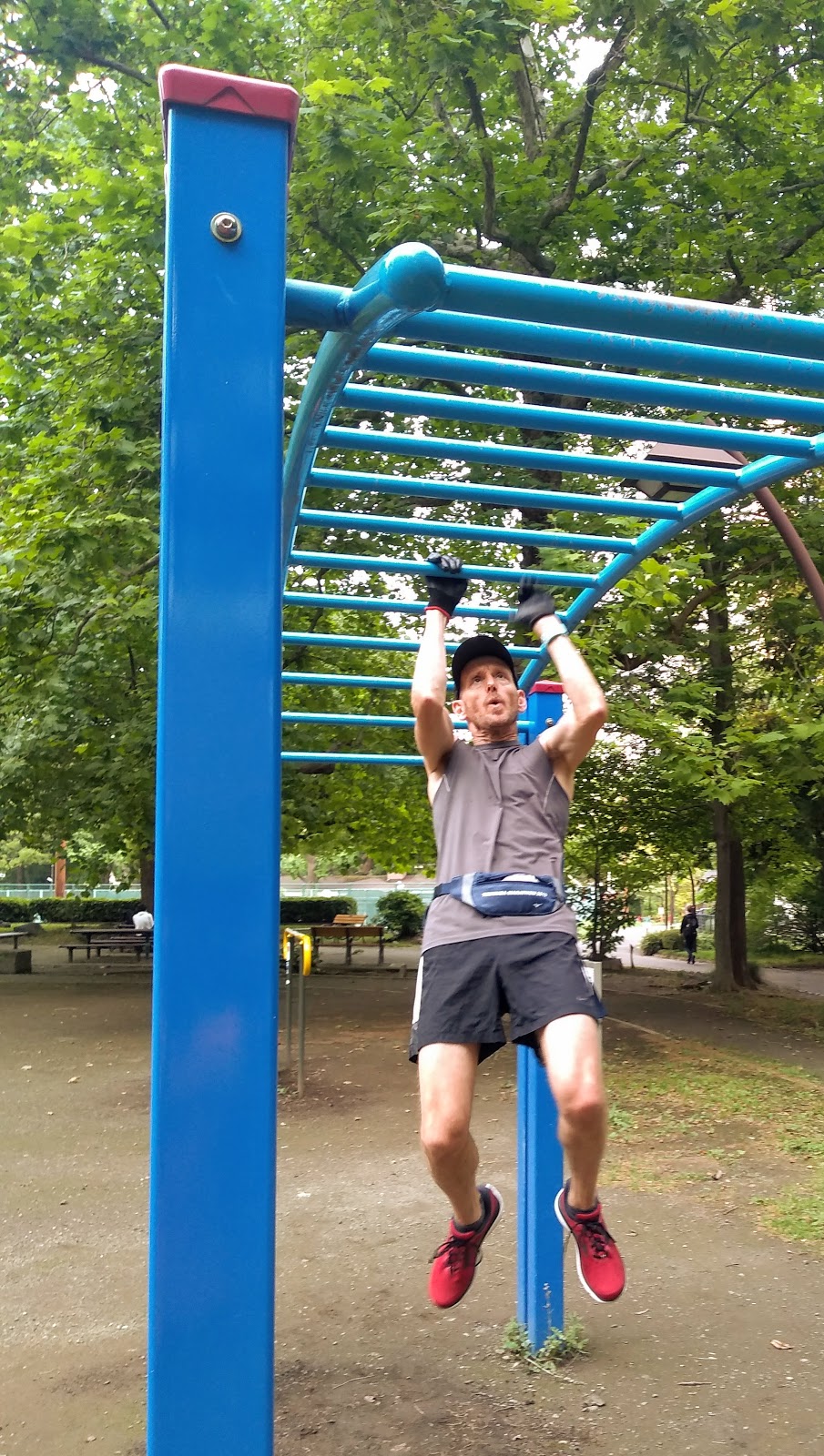
My Murph Test training of a year ago has morphed into a workout that has become a core part of my training regime:  


Twice per week, usually on Monday and Friday I jog to nearby park and do a variation of 3-5 sets of the following: 


  • 20-25 chin-ups


  • 20 jump squats or jump lunges (alternating) 


  • 25 push-ups mixing in some other core plank work 


  • 1k run around park with some bounding / high knee / sprints on grass or dirt field 


The park workout has some clear advantages - 
  1. Time management - In one hour I accomplish strength, cardio, core and form work -- versus the time-consuming showering and changing and travel involved in separate running and gym sessions
  2. Financial savings - The park is free 
  3. Enjoying the outdoors - Always good to get outside, especially lately, and especially in scenic park surroundings 
  4. Working on weaknesses - I never ever broke up my usual stay run or strength sessions to incorporate explosive movements like jump squats, but they serve as break between push-ups and chin-ups 


That said, when the fitness center fully re-opens I anticipate paying the monthly  fee and start swimming and lifting weights. 

But I won't entirely abandon my park workouts.  


Tuesday, June 16, 2020

Training in a Pandemic - Zwift


Over the past few years I have noticed fewer and fewer cyclists on Strava posting rides in the real world. Instead I see them post routes in Watopia, Richmond and Yorkshire - the virtual bicycling world of Zwift.  They tell me how Zwift has made indoor cycling so much more fun and more motivating. 

But I had assumed that the “dumb” turbo trainer I had purchased some 15 years ago was not compatible with Zwift, I was not confident I could figure out the technology, and anyway, I figured that I had enough entertaining and motivating videos to watch on Youtube on my Apple TV while cycling indoors.


Then in early April the combination of the lockdown and learning that a $75 investment in Wahoo speed and cadence sensors would quickly and simply allow me to setup Zwift spurred me to become a Zwifter.  


It was cool to jump on my ancient bike, start pedaling and see my avatar spring to life and move out amidst the other avatars - cyclists from other time zones around the world.  At first packs of cyclists raced past me, but within a few minutes I found myself drafting off a Canadian cyclist.  Of course I became obsessed on staying with her as we traded position for the next 10 kilometers, sweat pouring off me as I maintained some 150-200 watts & 25-35 kilometers/hour according to Zwift.  It was only when we started climbing a 8 percent grade hill that I fell off as my speed plunged to 5 kilometers per hour and my Canadian friend disappeared into the distance.


This struggle climbing hills in Zwift has proved the most intriguing issue for me and points to the question of whether my Zwift avatar actually matches my effort.  In a strange reversal from the real world, on Zwift I am glacially slow climbing and rocket fast on descents.  This creates an interesting new twist on my cycling tactics. 


Is it worth the $75 and $15 per month?  If you are going to do a lot of indoor cycling, then Zwift seems absolutely worth the effort.  But in the best of worlds I think we would ride outdoors rather than in a virtual world.    

Sunday, April 26, 2020

Racing in the time of Covid19 - Litchfield 10k

I had planned to enter more events this spring after a bit of a hiatus from racing in 2019.

So much for that plan.  

I am glad that I did manage to do one race this year before our world shut down -- the Litchfield Park 10k.  

At the time I entered the event, I anticipated it being something of a hard tempo training run with the benefit of other runners to push me along.  Now, a couple months later, the Litchfield Park 10k looms as my big "A race of 2020" and I realize that I need to post about my glorious effort.  

It was a small field of 100 on a rare, rainy morning in Arizona.  I tried to do a sufficient warmup, get some adrenaline going, and go out reasonably hard -- but still my time was well over 4 minutes for the first kilometer.   I found myself in 6th place at that point, with the leaders almost out of site, hundreds of meters ahead of me.

I exhorted myself to push and get in a good training session (and somewhat justify the $22 entry fee if nothing else).  I moved into 5th place, then 4th, then 3rd, and by 2k caught up with the high school kid currently in 2nd place who was fading badly.  I encouraged him to keep pushing, and he responded emphatically that I should go after the leader.  And so, at a bit past 3k, I pulled up behind the leader, and for the following several kilometers I told myself to be tactical and stay tucked behind him.  

One thing to note about rainy days in Arizona is that massively deep water puddles accumulates in "washes"  and on street corners.  So we found ourselves splashing though ankle deep puddles and at one point even an almost knee-deep wash.  I remind myself that these water hazards plays to my strengths after doing several obstacle course races - and after one deep puddle I find myself inadvertently moving into the lead.  

OK now I am committed, and as per my training from years ago, once I take the lead I feel compelled to surge and to never look back.  I am a bit paranoid about being overtaken, but end up winning by about a minute. 


I finish in almost exactly 40:07 -- I couldn't quite summon the kick at the end necessary to break 40 minutes, not that I particularly cared at the time.  Of course now that this time totally and completely represents my running ability for some time, it would be nice to have at the very least to have a sub-40 clocking.  

Nonetheless it is glorious to win even if is a small race.  The gratifying part being how the award ceremony moved upward though the age categories until reaching the ancient 50-59 year old category before announcing the overall male winner, which did seem to impress the smattering of people who had hung around to that point.   

So with no races in sight, at least I can spend my days fondly reminiscing about Litchfield 10k... 

Monday, December 30, 2019

Running in Sukhothai (and two 10k races)


I journey back to Southeast Asia, the one place where I have enjoyed sports glory in recent years.

This year I enter two running races on consecutive Sunday mornings - the first -Bangkok
s Rama VIII Bridge 10k and the second event the Chiang Mai Mini-Marathon.

Between the events I travel the 700 kilometers between Bangkok and Chiang Mai  by train and bus, spending several days in Thailand
s original capital- Sukhothai.

Sukhothai was the center of a vast empire in the 13th century, but now it is a sleepy rural town, way too far off the track to attract hordes of tourists. This makes it an absolutely superb training destination. The historic park area is a sprawling collection of ancient temple ruins surrounded by well-groomed lawns perfect for bounding and strides.  


The ancient city walls make for nice long contemplative runs on soft surface especially in the hours around sunrise and sunset.


I just wish I was not so tired -- tired from my paranoid finishing kick over the final kilometer of the Rama Bridge 10k..


The Rama Bridge race, along an expressway in the hours before dawn, is flat, fast and relatively cool for this region. With so little to distract me up on this expressway, I find myself locked in an internal struggle to stay positive. I hit the turnaround in 18:44 and am told that I am currently 3rd in my division. Knowing that only the top three receive awards, I obsess with fear of being overtaken.  I am so paranoid, that despite my mounting fatigue  I somehow summon energy for a desperate surge with well over a kilometer to go, accelerating my pace to under 3:30 per k for over 800 meters.  The final 500 meters is an agonizing slog.

I manage 9th overall and 2nd place in my division, which means
big prize money 4,000 baht (well, big money for me anyway given my impoverished financial situation and low costs in Thailand). With my race times slowing down and always one other guy seeming to show up and blow me away every race, I look for triumph wherever I can.

My official chip time for the 10-kilometer? distance is a respectable 37:16. But upon seeing the results afterwards I wonder if maybe I should have been more tactical -- and saved energy for running in Sukhothai and for Chiang Mai. 

So then during the weeklong journey north I sleep 10 hours per night to fight off a cold and to ready myself to defend my age group title at Chiang Mai. 

This is my 4th time running the Chiang Mai 10k, but this year the kilometer marks are short which makes me believe that I am running much faster than I am this helps give me a confidence boost early and makes the race more enjoyable than the stressful, mental challenge of the previous week. I am only slightly disappointed as I note the rather slow time of 40:45 for 10.5-kilometers? when I cross the finish line. Most any disappointment is dispelled when finish line volunteers put the division 1st place tag around my neck. 


At Chiang Mai I win 3,000 baht of prize money


and, even better -- this funky elephant tower trophy:


At the awards ceremony we discover that we are not the only athletes traveling and working the Thai running circuit.  We meet Kindu Swemehon who had also competed in both the Rama Bridge and Chiang Mai races.  However Kindu competes in the half-marathon and full marathon and is the overall winner of both of them.  So as rugged as we might claim that our week of travel and racing was, it is relaxing compared with Kindu.  For now I will hold off on leaving my day job and joining the Southeast Asia Running Tour full-time.  

Wednesday, December 04, 2019

2019 training summary - Long, slow running makes me feel slow


I struggled to return to running form after all my races last May.  My summer "off-season" was dismal - I can't seem to fully shake a series of aches and pains, and never truly feel strong and smooth and comfortable -- especially on longer, steadier runs (which I did more of as you can see below).  I consistently feel worse after long runs than after much harder shorter interval sessions. 

Moreover, I fall back into the slower group at Wednesday night intervals and lose hope of ever rejoining the fastest group as I age farther into my twilight years and decrepitude takes a cruel and bitter toll.  I find myself envying all the less injury-prone runners who can handle greater volume.  

Here is a summary of the massive (for me) increase in volume over the July-October period:


My one consolation is my improvement in chin-ups -- I receive endless kudos whenever I record 5x20 chin-ups on Strava.  I am tempted to set up a chin-up a bar next to the track and challenge people to chin-up contests in order to counter the dispiriting impact of my desultory running. 

Finally in November I scale back on the volume as you can see above.  I also decide to start "racing" the Wednesday night intervals again - hanging on at the back of the fastest group in sub-3:30 pace and enjoying the fact of being back up with my younger teammates. More importantly, the visceral pleasure of the sport returns - I sense more endorphins, especially on my intervals and my weekly session at park alternating between running and calisthenics.   

Tuesday, December 03, 2019

Autumn 2019 Races

I have have generally entered some sort-of race almost every month of the year.  But this year I go almost 6 months without entering any real events (as much as I like to consider my Murph Test a major milestone event). 

I enjoy treating the training sessions as ends in themselves. But, alas, I need to be able to answer the question "what is your next race?" which is the most common query at my clubs.  So I sign up for the Tsukuba 10k, a reportedly flat and fast event. With all the time leading up to the event my expectations naturally build.

But then after all the build-up I have a inexplicably poor run.  I go out in a reasonable 3:45 pace, but proceed to fade dramatically from there, finishing in about 40:30.  

Like my first race coming off long break at Nagareyama, I feel weak and I feel that I surrendered under duress.  But at Nagareyama I had the sensible excuse of self preservation in the unseasonable heat.  At Tsukuba, (like any event), there were plenty of little challenges: wet shoes, limited warm-up, sleep issues leading up to event, niggling injuries prior to the event, 180-degree turnarounds, etc., but none that justify such a pathetic showing. 

Fortunately last week there is a 5k time trial at the track and I manage to crank out a respectable 18:16 restoring some semblance of confidence and a willingness to enter races in the future. 

Thursday, November 21, 2019

Athlete's Heart Followup (Plant based diet)

Plant based diet for runners
After my recent post mentioning all the hamburgers that I could potentially eat after hearing the cardiologist’s feedback, I am barraged by angry messages from all my plant-based diet triathlete teammates. They objected to my selfish disregard for the impact of beef production on the environment.  

So in order to mitigate the climate impact of eating hamburgers, I fly to the US where the plant-based Impossible Burger has suddenly become ubiquitous.  I am able to stop by a nearby Burger King after a training session and experience the genetically modified burger that my teammates have been endlessly talking about.  

At $8 for the Whopper and a small coffee, it is not a bargain - economies of scale have not kicked in yet on what I assume would be large potential savings from lab-based production.


As far as the taste test?  Well, it totally tastes like any other Whopper as far as I remember.  I am not saying that is good or bad  (one thing I would definitely say is the BK Cafe coffee was surprising good).

As far as the long-term nutritional trade-off?  I have no idea, that does not seem at all clear, or the point of the Impossible Burger anyway (the objective was helping the environment).   But I do have to think that if you go to a fast food restaurant and default to the accompanying fries and large soda meal plan you are compromising your training regime.

But now after eating the plant-based burger and then followed up by watching the popular new Netflix documentary, Game Changers, I have to feel a bit more hopeful about this week's 10k race.
   

Friday, October 25, 2019

Athlete's Heart

The primary physician at my annual health check gravely informs me that my electrocardiogram shows a T-Wave Inversion, suggesting a possible myocardial ischemia, which is apparently a bad thing.   He recommends that I visit a specialist.


Days, then weeks, go by.  I procrastinate on scheduling the appointment with a cardiologist.  Maybe I am in denial, but I do know that the recent years of exercise do not make me bullet-proof — all the years of stress and lack of sleep and eating breakfast cereal for dinner must have taken a toll.  Some research suggests that excessive endurance training is in fact bad for the heart.  

Then in September I meet one of my seemingly indestructible endurance teammates and am stunned when he tells me that he recently had a stent inserted in his coronary artery.  This guy is a horse — he constantly bounced back nonchalantly from races and workouts that left me shattered.   My attitude has always been to avoid any medical action unless it is clearly necessary — in this case I recall reading that one should not get a stent unless you are actually having a heart attack, doctors often feeling compelled to do something, anything - even if something was likely to lead to worse outcomes.  

More than that, I am certain the specialist will recommend draconian changes — no ironman distance triathlons, no sprinting up hills, no coffee, certainly no heavy cream in my coffee.

Finally I schedule the appointment and in days leading up to appointment I become increasingly morose.  I wake up feeling terribly distressed on the morning of the appointment and trudge to the clinic with a heavy heart (so to speak), the scene from the movie Bohemian Rhapsody where Freddie Mercury receives his terminal diagnosis fills my head.  As I sit waiting for the doctor, I envision asking him to be straight with me and tell me exactly how many days I have left. 


Then the specialist strolls in, takes a cursory glance at the electrocardiogram, looks at me for a moment, and says: “So, can I ask about your lifestyle… for example, like, do you exercise a lot?”  

I pause, wondering what he means by “a lot”

On the Strava Leaderboard for my triathlon club I have logging maybe 6-10 hours of weekly training,  this is only half of the hours of weekly training versus, say, Stan or Jean Marc.  

“Well” I begin to answer, “I only do about 7 hours per week during the base season, but that does not include the core and strength work, and though my recent half ironman time was slow...”  

He abruptly cuts me off as soon as the words “half-ironman” leave my mouth. I was keen to fill him in on the details of my Spartan training exercises, my weekly ratio of volume vs. intensity, and the progression of how many chin-ups I have recently worked up to.

He proceeds to tell me that I likely have what he characterizes as an “athlete’s heart” and I shouldn’t worry.  We do an (expensive) ultra-sound test which seems to confirm his diagnosis.  

I am relieved, but still have one question - the primary physician had also pointed to my high level of bad cholesterol as a warning signal I should take heed of and make big changes in my lifestyle.  I hand the cholesterol test results to the cardiologist and ask if I should be concerned.  

"Naah"  he says dismissively waving off the document like some worthless scrap of garbage, "In your case I wouldn’t really worry about that at all".  

OK, so much for my nascent motivation to embark on an ascetic, vegan diet — I guess I will continue to put full-fat, 40% cream in my coffee and continue to eat hamburgers.

I still don't think I am "bullet-proof" because of all the endurance sports training, but at least there are no immediate, obvious adverse cardiovascular impacts.