Sunday, August 18, 2019

Murph Test


Last weekend I did my “A Race” of the season.  The focus of my training this summer has not been a glamorous Ironman-branded triathlon a famous big-city marathon or an impressively long ultra-distance trail race, but rather a series of basic exercises on a quiet morning at a nearby track  — a series of calisthenics known as the Murph Test

The Murph Test is comprised
of a one mile run followed by 100 chin-ups, 200 push-ups, 300 squats and then another 1-mile run.  The idea is to test yourself by doing the Murph as fast as you can.  There is an elite version entailing wearing a 20-pound weight vest and doing each set of calisthenics consecutively.  I do a more normal version and break up my sets into rounds of 10 pull-ups, 15 push-ups and 20 squats.  

I was originally inspired to do the Murph Training about a year ago after listening to an episode of the Endurance Planet podcast and hearing the podcast host, a burned out runner/triathlete, talk glowingly of having just accomplished a Murph.  I have long been very keen on maintaining strength through goal-oriented calisthenics and I was seeking some sort of incentive to do strength work outside of the gym.  The Murph Training inspired me to find chin-up bars on my running routes and power through long sets of pull-ups. .  The 4-year old children were delighted to see me jump on their monkey bars and start doing sets of 10 pull-ups, but I got strange looks from the fathers accompanying them to the playground.  

I would encourage everyone to train for the Murph Test.  Unlike the Spartan Races, the Murph poses limited risk of injuring oneself, which is the excuse other aging triathletes and runners keep giving me when I try to persuade them to join me for obstacle races.    But I seriously doubt I will convince many of my endurance sports teammates to embark on something so unglamorous, painful, and tainted by its association with Crossfit.  In fact I was very surprised that I was even able to talk a half dozen of my obstacle course teammates into joining me.  Their presence proved a big help versus trying to do it all on my own. 

We started together, and thanks to the group dynamics I go out briskly on the run and complete my mile in just over 6-minutes, not wildly fast, but fast enough to leave me with an elevated heart rate and out of breath on my early rounds of calisthenics.  I have to think that maybe 30 seconds slower on the first mile would have resulted in more than 30-seconds of gains on the pull-ups and push-ups.   Still I am able to maintain the pace of 10/15/25 reps until I hit 80 pull-ups at which point my arm strength suddenly fades and I can only manage to finish off the pull-ups with sets of 6 reps, 6 reps and then a last gasp 8 reps.   My arms feel too tired and heavy to swing as I start my second mile, and I am surprised I am even able to hit 98 seconds on first lap and 6:40 total for the second mile with a big finishing kick.  

I complete the Murph Test in 38 minutes 40 seconds.  I understand this is a respectable time -- according to some unofficial Murph websites, beginners should try to break one hour and breaking 40 minutes represents an "advanced" effort.  Now I just need to do the Murph Test in the same time wearing a 20-pound weighted vest (which typically adds ten to twenty minutes to the time) and my mark would rank among the top in the world on the Murph Challenge Leaderboard.     

And presumably in my advanced age group I would rank ever higher. I am not aware of any age-adjusted Murph Test ranking, but according to an informal survey on Bodybuilding.com roughly a quarter of all US males could do 10 pull-ups. The President’s Council on Physical Fitness recommends men be able to complete 8 pull-ups and the minimum pull-up threshold for Marines is 3 reps.

Not that I am competitive of course....  I just like having benchmarks as I train for another Murph Test next month.

Sunday, June 30, 2019

Good to Go - Striving to optimize recovery


Gauging recovery has always been a challenge for me — in the past when I have paid close attention to whether or not I am fully recovered and sought to wait until I am totally “good to go” - my training has dwindled to almost nothing. 

Last month was particularly difficult.  I had to deal with preparing for the three races in three weeks in three different sports and incorporate several dedicated, weekly obstacle course training sessions on top of my usual swimming, cycling, hill repeats, and track intervals.   Plus I needed to recover from the stress of the events themselves.  Moreover I had some travel and work issues to deal with.


So in an effort to better assess whether I am sufficiently recovered,  I try RestWise, a “fatigue monitoring system”


I sign up for a month of RestWise and every day I input various objective measures such as resting heart rate, oxygen saturation, sleep quantity along with subjective assessments of mood, muscle soreness, energy level, appetite, etc.

The RestWise app spits out a Recovery Score which informs me whether I should exercise that day:


You can see from the output how I struggled with recovery throughout May and early June.   I was already worn out from doing a variety of training during the Golden Week holiday in early May.  Then, while at first I seemed to have recovered well from the 10k on May 12th, the obstacle race and probably the anticipation of the triathlon took a toll.   Then once fatigue hits it takes a while to get back on track.


I am influenced by the new book “Good to Go” which had positive things to say about RestWise.   And Good to Go takes a very skeptical view of most recovery products.  Good to Go’s focus is on the billion dollar sports recovery industry that has sprung up to accomplish something that is basically just the passive process of resting.   The "active" recovery things we all love (foam rollers, massage, hot/cold baths) do seem to really work and make us feel better — however most of this benefit isn't a direct effect of the treatment, but the fact that the treatment simply helps you relax more.  


I find RestWise helpful.  But unfortunately the process of inputting this data on muscle soreness, sleep quality, appetite, mood, etc, seems to lead to me dwelling on my fatigue and creating a negative feedback loop. 

Tuesday, June 11, 2019

May 2019 Race #3: Korea Half Ironman Triathlon

Goseong Half Ironman


Ten members of our triathlon team travel to Korea to compete in a half-ironman event, my third race in three weeks in three different types of endurance event.    


I feel less than “heroic”  — I am the weakest triathlete among our highly driven, focused and competitive group.  Obviously I am not “focused” on triathlon, but this is my best chance in 2019 to test myself, and I want to make the most of it.  


Essentially this is a repeat of my experience last year going into the Cebu Triathlon,
  • I am drawn by need to do at least one race per year and identify as a triathlete
  • I am more interested in opportunity to travel than race itself (in this case visiting the surprisingly impressive beach in Busan along with the southern Korea dinosaur country) 
  • My preparation is strange mix of track intervals, Spartan workouts, short swims at Spa and short indoor trainer rides
  • Even though this is my longest race of the season, I don't really consider it my "A" event  
  • Getting my bike to the venue is terribly stressful and tiring - this effort strikes me as being more demanding than the actual triathlon


The big difference from last year is that in Korea I don’t have the excuse of running in tropical heat, swimming in strong currents and cycling on a tight, crowded course.  Conditions are perfect.   The run is on rolling hills which allows me to mentally break up the effort.  The cycling course is scenic.  The swim is in calm water, albeit roiling around me with other swimmers


I am kicked in the face early in the swim, struggle a bit with water leaking in my goggles, and spend the rest of the swim on the outside edge of course.  I feel like I am making up ground on the bike, managing to maintain what feels to me like a very fast pace through the whole 90k (although I just fail to hit my goal of breaking 3 hours).  

Goseong Triathlon


Ultimately I am happy simply to complete the course and be able to legitimately identify as a triathlete for another 12 months.  But I finish well behind 8 of the 9 TiT teammates and 306th among the 1,455 finishers.    Here are my splits:

Swim  - 43:30 
Bike -  3:00:18
Run -   1:38:27

Total -  5:32:35 


Tuesday, June 04, 2019

May 2019 Race #2 - Obstacle Course Event


The second event of my 3 consecutive races over three weeks is my “A race”  — an  obstacle course race encompassing  25 obstacles over 13 kilometers on a relatively runnable course (versus the earlier obstacle event). 


This is my third obstacle course race, and I am determined to improve on earlier efforts.  


Unfortunately I don’t get off to a flying start — as you can see here I am a bit boxed in and unable to take advantage of the early runnable section of course.  


I come off the first few obstacles gasping and struggling to get back into a running rhythm.  Things improve as I conquer the plate pull, the Hercules hoist and the Olympus -- obstacles I struggled with in my previous events.  I overtake numerous “gym rats” on some long, flat sections of the course and am feeling pretty chuffed.  


However the long bucket brigade takes a toll on my forearms, not to mention the general fatigue of constantly needing to surge and summon "explosive strength" to get over the obstacles, and toward the final third of the race I find myself trudging behind some slower runners on some narrow twisting climbs.  Then I am completely flummoxed by the Twister obstacle  -- which I have obsessed over in the weeks since the event.  


Every other Spartan “warrior” seems to be holding hands and smiling for pictures as they hurdle over the fire jump photo-op at the course finish.  Not me - as I approach the final 500 meters I spot another old looking guy, and feel compelled to sprint until crossing the finish line.  

It turns out this guy was 10 years younger than me and like last September’s Spartan race, there are few other geriatric athletes competing - only 9 guys among the 500 age-group competitors are in my age division.  I manage to outrun all 9 of them and win the division by close to 30 minutes — my finishing time is roughly 1 hour and 36 minutes.  


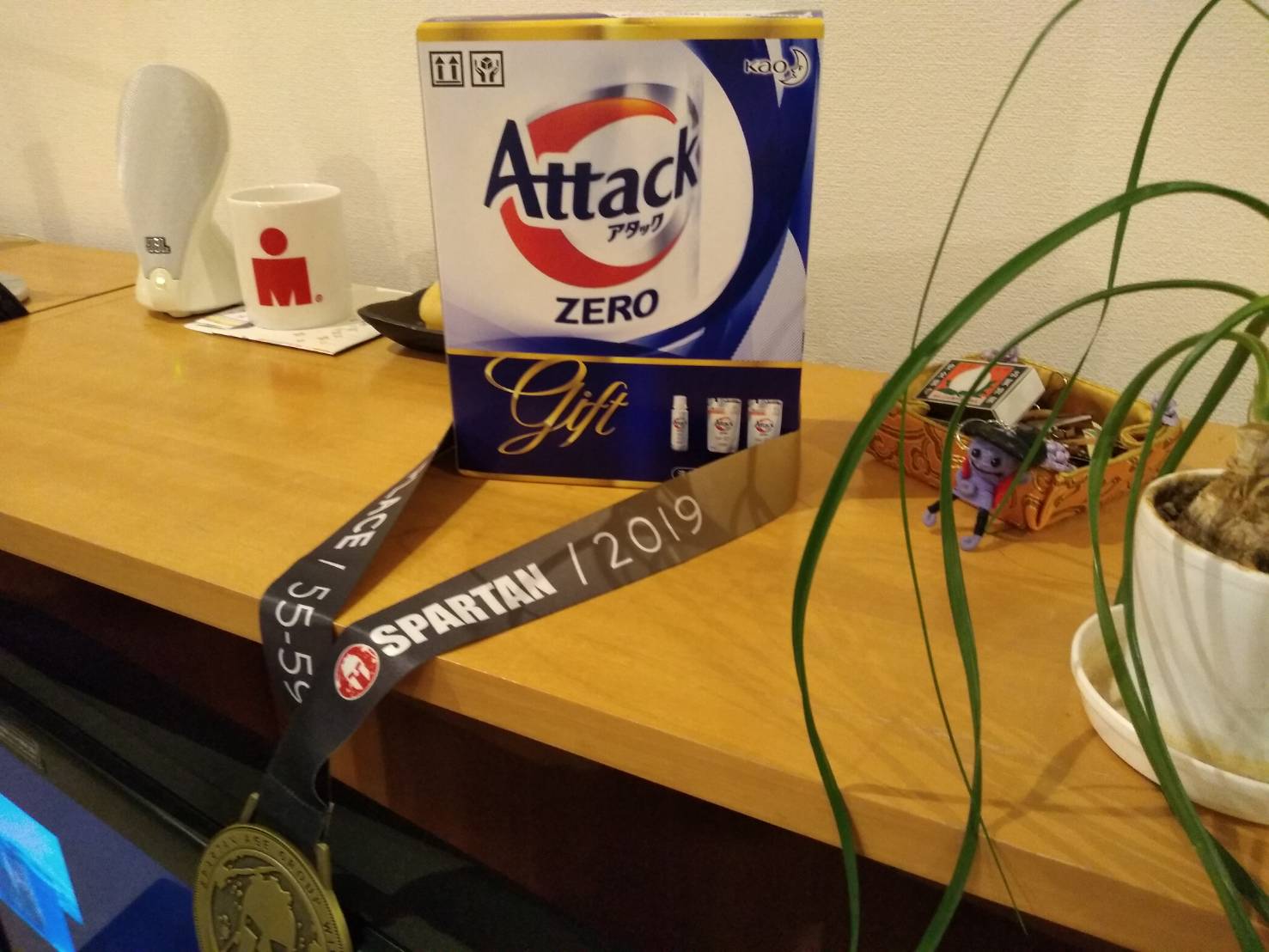
You can see how jubilant I am to win the prize — a box of laundry detergent - a very suitable prize for after a muddy obstacle event…


…however my box of detergent is still serving as a trophy on a bookshelf.

Thursday, May 23, 2019

May 2019: 3 races in 3 weeks


I enter 3 races in 3 different endurance sports over 3 consecutive weeks.  This is not the sort of race scheduling that a coach would recommend, but as always, my plans are largely driven by social factors.

First up is Fuji-Susono, the hilly 10k race which has become the one constant in my annual race schedule.  

This year Fuji-Susono restores my love of mixing it up in running races.  After the increasingly stressful winter training runs and discouraging winter race campaign, Fuji-Susono is pure endorphin-producing outdoor joy in the sun — more like the days of play during childhood.  

I know that might seem improbable given that we are talking about an event that entails running 4 kilometers steadily uphill.  But I was telling myself to hold back and simply seek to be on the podium — meaning I just needed to be in the top 10 among guys wearing numbers 3500 to 3650.  In the final part of the race I let myself pick up speed and start knocking off these targets like in a video game and in the final 500 meters I open up a frenzied kick - zapping two more 3500s - and ultimately finishing 4th in my age group.  

That my finishing time is a desultory 41 minutes is of limited importance.  What matters is the fine weekend out with friends, the moments of being in the run - and that I avoid trashing my legs for the following week's Spartan Race.   

Friday, April 19, 2019

Winter 2019 Run Training & Races


It was a rough winter.  


My run volume drops even further in early 2019 - from already low monthly levels in past years I drop below 200k in November and then to a meager 70k for entire month of February: 

Skiing, snowboarding cut into training.  And short almost daily swim sessions, indoor cycling and daily strength work make up even higher percentage of my weekly routine.  A niggling injury fuels a diminished desire to add volume.   

Surely I have maintained overall fitness, but running stamina seems to have suffered.  Foolishly I lose sight of my long-term perspective on enjoying the process and get fixated on clocking a fast 10k time.   This does not happen.  On two flat, fast courses I only manage to run 38 minutes for 10k - in both cases fading over the last half of the race.  
  

But now thoughts turn to obstacle course training 


Wednesday, March 06, 2019

Plank Streak - Now at 58 days in a row


A few months ago one of my teammates talked glowingly of his “running streak” (consecutive days of running at least one mile).   Another teammate created a Strava support group designed to build peer pressure and camaraderie around the shared goal of maintaining a daily run habit).    Given my long history of injuries, all my efforts to cross-train, my emphasis on recovery-based training and trying NOT to run when I am tired - I immediately reacted with a sense of disdain.  Moreover I was simply puzzled by the need for this effort since I have not gone an entire month since 1980 without running -- the activity is so baked into my life that I feel like I might just as well tabulate a “breathing streak” (hey - I am up to 365 x 56 days of taking a breath).   


This immediate sense of disdain  is only amplified a few weeks later when I am listening to the Endurance Planet  podcast and the coaches absolutely disparage run streaks - pointing to a obsessive compulsive athlete whose flu only worsened after his dogged determination to keep a streak going. 

So I start annoyingly pontificating about the foolishness of run streaks.  Around the holidays  I scornfully bring up the topic with other teammates who are long-time triathletes and who I expected to share my dark contempt.  In both cases it turns out that they happen at the moment to be enthusiastically adhering to run streaks and they extol the streak's motivating force.  At this point I feel like I am a jaded, mean-spirited, supercilious curmudgeon.  

I decide not be so narrow-minded and embrace the power of streaks.  While I obviously have no plans to start a run streak - instead I note just how lazy I have been about doing core exercises.  The powerful reality is that I should do these exercises every day, but far too often the day slips away and for one silly reason or another I don’t make time to do them.  


So on January 6th in the spirit of  exercise streaks I begin keeping track of how many days in a row I do a full 4-minute plank routine.  My plank routine entails side plank, leg lifts and push-ups — to qualify, each day I must stay up in plank position with knees off ground for 4 (now 5) minutes.


I find the power of recording a daily streak to be remarkable.   Whenever I realize the day slipping away I make sure to do my 5-minute routine no matter where I might happen to be — on train platforms, in the small space in front of the airplane restrooms, on pool decks, elevator lobbies, wherever.   As of today I am up to 58 days and still going strong and becoming an evangelist for (at least some) exercise streaks.

Sunday, January 06, 2019

Chiang Mai 2019

After a string of second place finishes I am just so pleased to receive this big "Winner" banner, especially amidst a splendid award ceremony with such fine photo ops.


I managed to overtake a 50-year-old German guy leading the age group at the 4k mark and add 50-second to my winning cushion. 

This is my 5th time doing the Chiang Mai event which always starts as just an excuse for a low-cost, runner's reunion in northern Thailand.  While the trip starts out as a leisurely winter escape, when the starting gun goes off, I have always raced with full intensity.  

This year all kinds of aches and pains leading up the race forced me to hold back a bit at the start.  It turns out that a jam-packed starting line with hundreds of runners crowded in front of me meant that I had no choice but to start slowly -- 4:06 for my first kilometer (compared to 3:37 at last month's Toda 10k).  

The slow start means that I pass other runners throughout the whole race and means that I feel strong and comfortable.  I felt fast, so much faster than the agony of hanging on during the middle of recent races like Toda.  

As far as my time is concerned, well, I guess the slow start means that as good as I felt, I never really get up to goal 10k speed. Conditions were certainly ideal. But it is difficult to even gauge my performance exactly since the organizers are more interested in staging an elegant run around the walls of the Old City than a precisely measured 10,000 meter race.  I was perfectly fine with this -- in fact I was absolutely delighted when I saw the finish line and knew I won the age group and could stop running, no matter that my GPS watch indicated I had only run 9.4 kilometers (in 36:25). 

The 7-year old daughter at the family-run guesthouse where I stayed was the person most impressed with my being the "winner".  She was particularly charmed when I gave her my very precious "Winner 3,000 baht" banner  (which admittedly was not such a generous gesture since this bulky cardboard placard was too big to carry home....)

Meanwhile I envy my running mates with their more reasonable competitive outlook and team spirit who are picture here finishing the race together -->

Wednesday, December 12, 2018

High Performance Vegetable & Fruit Smoothies


My sleep post was apparently so boring that most of my remaining followers immediately cancelled their feeds. 

So in this post I will give the audience what they want — the one thing that endurance athletes actually all seem to care about — discussion about smoothies.

Yes since last summer I have been making smoothies every morning.  Originally the idea was to simply trick myself into eating more vegetables  (when you are surrounded by Vegan triathletes demonizing meat and dairy, and Paleo Diet triathletes demonizing bread and fruit, you can’t help but start to feel that vegetables are the only safe food choice).   

High Performance Vegetable Fruit Smoothie for endurance athletes

Now in addition to improving basic daily nutrition, I learn that smoothies have performance-boosting powers*

Was my recent PB at Toda 10k due to the smoothies?

I am a sloppy and lazy cook, but even for me making a smoothie is a forgiving enough process to be almost fun.   Now I am finally adhering to nutritionists recommendation to have vegetable at every meal (the trick is to add just enough fruit to make the smoothie taste like the sweet American breakfasts I grew up with, while still tossing in a full serving of vegetables).   Moreover the texture and green hue of the smoothies just feels and looks so darn healthy that I simply feel stronger as I drink it (OK, maybe this is a placebo effect, but as more knowledgeable athletes have told me about the placebo effect, if it works -- bring it on). 

So here is my special, performance-enhancing recipe:

1. Take a totally random amount of the following ingredients: 
  • Spinach 
  • Carrots
  • Almond Butter
  • Chia Seeds 
  • Bananas
2. Mix in blender
3. Serve Cold  


I will be sure to track whether my special smoothie diet leads to further race improvements. 


  • Yes, that's right, my takeaway after recently listening to hours of seemingly authoritative fitness podcasts is that diet, particularly smoothies, are the primary driver of endurance sports performance.  Personally I had always thought that the key variables were genetics and training, with belief and execution playing a key role, and things like sleep, stress, and diet being merely factors that if neglected could derail the rest of your program.  But apparently it is mostly about the smoothies. 

Friday, December 07, 2018

The Sleep-Deprived Triathlete


Way back in the earliest of posts in this blog, I lamented being such an outlier in terms of sleep.  I have never met anyone who has needed (or admitted to needing) the steady 9 hours of sleep I seem to require.  For that matter I hardly ever speak to other athletes who even acknowledge needing a mere 7 hours of sleep which is allegedly well below the average minimum required.     
    
So I am the type of person inclined to read this new book called “Why We Sleep”  


The book is hundreds of pages of research extolling the need for sleep.    


This chart is particularly striking, showing how among a study of young athletes, chronic lack of sleep correlated with a massive increase in sports injury (a far greater predictor of injury than hours spent practicing the sport, strength training, stretching, etc).  

The book even goes on to link athletic performance with adequate sleep. 


The book is so vehement in its blaming lack of sleep for almost all health problems that even I, the biggest of sleep partisans,  begin to wonder if the author is over-stating the importance of sleep.  I start to look at all the chronically sleep-deprived people I see dozing off standing up on trains and worry they will start simply dropping dead around me.

One of the big takeaways from the book is that one should maintain the same sleep schedule night after night, avoiding long naps and avoiding trying to make up for lost sleep on subsequent nights.  Unfortunately, since I am one of the 30% of population with a night owl type of circadian rhythm and struggle to fall asleep in the evening, I find after just one later night to bed I struggle to revert back to the desired early-to-bed schedule.    Of course I have also always been struggling to join my militant teammates who always wish to meet at 6am for an early ride or swim.

While traveling to races has been the big challenge to meeting my sleep needs, strangely, crossing the 8 time zones over the Pacific Ocean has helped re-set my night owl pattern and allow me to wake up early.  So in the weeks since my recent trans-Pacific flight I have been diligently seeking to stick to a 9pm to 6am sleep schedule, a schedule that is absurdly out of synch with the world around me. 

I have even cut down on caffeine (switching to a decaffeinated mix in the morning and always ordering cappuccinos when at cafes).  And I have eliminated alcohol -- and more or less any social life for that matter.   

It was nice at the recent Toda 10k to naturally just wake up before 6am without an alarm clock, and have lots of time before the race start.

However each night the struggle to fall asleep is a bit harder than the previous night, and it is upon waking each morning when the effects of the previous day's training session hits me and I wish to sleep in a bit later to recover.  So with travel, and evening work events ahead of me it is a big question whether I can maintain this early-to-bed program through my A races next month.   


Friday, November 30, 2018

Autumn 2018 Running Races


Would the limited mileage of “3+2” cross-training negatively impact my race performance?  Would my bounding prove to be some fountain of youth? 

I hoped my fall race campaign would elicit some clear answers. Ideally of course I would run some amazing times and be able to evangelize for these techniques.  Or if not, I would crash in burn in a manner that generates practical, actionable lessons for all future training. However the results were inconclusive —  the usual murky jumble of variables such as race conditions, terrain, fatigue, and race-day execution. 


Here is summary of my 3 October/November events:

  • Nagareyama 10k - 41 minute - On an unseasonably warm day I make a futile and foolish effort to attempt to run at my goal pace of 3:45 per kilometer (recalling the Munatsuki 10k event of several years ago where running in mid-day heat did not derail my performance).  I pride myself on not giving up, but at Nagareyama I totally capitulated.  At around the 3.5k mark I slowed down to grab water at an aid station and then didn't bother to speed back up. I consciously thought - "this is just stupid and pointless, I really don't want to suffer." Later after the race, it was revealing to witness the award ceremony and note that many of the athletes in my age group seemed to be made of much sterner stuff and clocked times around 37-38 minutes.

  • Cross-country - As usual, all attention turns to cross country in Seattle running world in October, and as usual I struggle to adjust to fast starts and the soft, hilly terrain. I cannot even make the top seven in my age group for the CNW team (out of like 10 guys). 

  • Toda 10k - 37:17 -  Technically this is my fastest 10k over the last two years - the 10k Personal Best for my current self.  This time (unlike Nagareyama) I managed to run faster than 3:45 per kilometer.  Granted, given the perfect conditions and flat course at Toda, I had hopes of maintaining a 3:40 pace.  I am pleased to finish 18th out of 1,551, earn a spot on the podium and join my teammates with shiny medals pictured below.  

Almost immediately thoughts turn to winter/spring races, and whether I can figure out how to break out of the plateau I have been in for so long, and eke out some improvement in my time.  


Thursday, November 29, 2018

Run Training Summary - 2018


My run volume has dropped by some 40% during the past eight months since I shifted into “3 + 2 Cross-Training” (compared to the 300 kilometers per month I was hitting in 2017):


"Easy" runs have frequently been replaced by swimming or cycling, meaning that some weeks entail only a hard interval workout, a hill repeat session and a long-run.  While there is certainly a question of whether this affects race performance, the bigger issue is whether I enjoy the easy runs versus the cross-training?  

Friday, September 21, 2018

10k Obstacle Course Race

I finish 2nd in my age group in last week’s Spartan Obstacle Course Race.  I attribute much of this success to the fact that the elderly don’t seem too terribly interested in participating in these Spartan-type obstacle events.  Only 18 of us over-50 age group athletes show up (among the 1,000 or so participants overall) -- a significant under-representation as a percentage of the larger population. 


I continue to find this disconnect puzzling given that explosive movements and balance and strength are precisely the things that I’ve been told to work on and try to retain since turning 50, as I mentioned in my post last year when I entered my first obstacle race - an easy team sprint event. Yes, competing in a Spartan race may seem like an extreme way to go about maintaining a strength conditioning program – why not just be motivated enough to go to gym 3x a week and plow through a training circuit like every normal, middle-aged guy?  In my case, after years of focusing my exercise effort around a year-long schedule of triathlons and running and cycling races, I overwhelmingly prioritize sessions that directly prepare me for an upcoming race - it creates so much more meaning and purpose.   

Not that doing bench press reps was necessarily the most race-specific training for this particular event. Rather trail running ability was the single most useful skill-set on last week’s course (which was held at a ski resort and had us running up and down ski runs).  In recent trail races in Vietnam and Hong Kong, I have lamented how poor I have fared when competing head-on with trail running specialists – technical descents have been simply embarrassing as I have to get out of the way of mountain-goat-type-runners dropping past me.  Against the "gym rats" at Spartan I was at least holding my own as we descended the grassy ski runs.  


I fared reasonably well on the obstacles themselves last week – slightly slower than many of the guys around me, but then I am so accustomed to doing strength work in the most deliberate and precise manner possible, and so hurrying through many of obstacles seemed unnatural.  At least I was able to burst into a run reasonably quickly coming off the obstacles. I found the wall climbs, and vertical wall traverses to be such interesting challenges and a fun break from the pure cardio events.  


I was suffering a terrible cold going into the race.  I say this only to note how much being in a race (the flood of adrenaline I presume) can block out the impact of an illness. Every endurance athlete has likely experienced this.  As you can see in the adjacent picture, I don't look particularly chipper as the race starts.   But at this event my cold symptoms shut off light a light bulb just as I hoisted myself over the first steep obstacle.  I guess if you were caveman and the saber tooth tigers attacked you couldn’t just call it in sick – you need to be able to compete at near 100% for the duration of the event. 


I had presumed this would be my last Spartan obstacle course race. The event registration is so expensive.  And I hate to risk injury.  And all the Spartan Warrior military crap is so hokey.  

But after feeling increasingly strong toward the finish and receiving all the accolades for finishing 2nd in the age group, I find myself mulling over and over whether I could improve on Saturday’s effort – using better technique on certain obstacles like the plate pull and vertical wall, bringing more concentration and urgency on a couple obstacles like the bucket carry, getting off to faster start, running on a flatter course, wearing racing flats and competing on a day when I am not suffering from a cold?

Monday, August 27, 2018

Cebu Half-Ironman

I dreaded the Cebu Triathlon.  I dreaded every aspect of it.  I dreaded swimming in choppy seas. Biking on a narrow, crowded course.  Running in mid-day tropical heat.  I dreaded the thought of all the travel and costs and logistics.


As usual in life and triathlon -- it all turned out well - I survived - I did not drown or crash or suffer heat-stroke -- I even managed 6th out of 41 in my age group, 243rd overall (out of 
some 2500 entrants), and enjoyed a memorable excursion to Cebu with a fun group of teammates.
  
Not that my fears were entirely groundless -- 

``
In fact the swim was choppy.  The rolling start was smooth enough, but when I rounded the second buoy and turned into the waves and the current I started to panic. I didn’t help that the swells pushed a slower earlier wave swimmer into me while 3 faster swimmers from later wave swam over me.  But I reminded myself that I have done this many times before, and powered through the rest of swim, staying focused on each stroke.   While my swim time of 47:16 minutes to cover 1.9k is a shockingly long time in the water, it was still among top half of finishers.   


And the bike ride did seem treacherous - at least at first when a dog ran across my path (reminding me of a childhood mishap), and countless riders burst past me (often then slowing down).   Training primarily on an indoor trainer (if at all) means that once again I am not terribly aggressive starting the bike, though I did find myself passing a lot of riders on the later laps.  The huge screaming crowd lining the course encouraged me.   While m
y time of 2:58:33 was slower than my other half-ironman efforts is as good as I might expect.  

And the run was hot.  A blazing sun burned through the clouds just in time for the mostly shade-less, mid-day half-marathon.  So I took walk breaks.  Numerous proactive, carefully timed walk breaks - roughly every two minutes.  I took leisurely strolls through every single aid station luxuriating in the feeling of squeezing the ice cold sponges over me and drinking cup after cup of sports drink or ice water.  When I actually did break out into a run I was reasonably strong - my time of 1:46:44 was OK (fastest in the age group).

Total time: 5:40:39


Cebu was my longest and "biggest" race of 2018.  By "biggest" I mean most talked about, most expensive, most anticipated and entailing the most travel.  But by "biggest" I don't necessarily even imply that it was my "A race"  -- the race that the well-coached endurance athlete would structure their training around.  Normally a triathlete's longest race will also be their A race -- it works best that way with tapering and recovery.  But my training leading up to Cebu included a lot of obstacle course drills and my key weekly workouts continued to mostly be shorter faster run intervals, just like the rest of the year.   At least I did manage some long, enjoyable bike rides in the mountains this summer with the TiT group, so it is certainly not the case that I went into the half-ironman "cold"  

Sunday, July 29, 2018

Lake Whatcom Triathlon


I need to do a couple triathlons each year to force myself to swim and bike a bit. So for 2018 I enter the lovely  Lake Whatcom Triathlon in Bellingham, Washington
(plus next week's dreaded Cebu Triathlon)


Lake Whatcom is a friendly, scenic local event.  The event is only in its second year and a couple hundred triathletes participated.  The locals are concerned about the 70 degree temperatures, but I found the weather cool and crisp and the Pacific Northwest lake is clean and refreshing  


My time for the Olympic Distance event is acceptable:


Swim -    28:38 --  105th - Nice improvement over my recent triathlons 
Bike -   1:18:48  -   50th - Slower time on reasonably fast course 
Run -       44:36  -  14th -  Faster time on slow course (winding trail with stairs) 


Transition 1 consumes a startling and amusing 4 minutes as I struggled endlessly to tug my wetsuit over my timing chip ankle strap.  I find myself with time for a long, philosophical discussion with the lackadaisical triathlete next to me at the bike rack covering topics ranging from existentialism  to how our transition time is going to look on the  results breakdown (we weren't the very slowest athletes in T1, but very close).


My bike time was significantly slower than my Olympic races a few years ago.  Most guys would point to fact of using their "B bike" and obsess over the extra ounces of bike weight.  I was more concerned over the lack of bike training again this summer, as well as not having any fast guys around me after starting in the last wave and being a slower swimmer.

Nonetheless this was one of my rare opportunities on a bike over the past couple years so I try to push a big gear and overtake people as best I can.


I seem to have dropped a notch in terms of competitive drive on the run - at least relative to the suffering I have pushed myself to experience on previous triathlon runs.  At Lake Whatcom, I felt pretty light and comfortable scampering around shaded trails that twisted over stone bridges and up and down hills and stairs in a gorgeous, old city park.  


Despite all my various issues and excuses, the effort is good enough for me to end up on the podium 

I finish 2nd place yet again (see my last 3 or 4 race reports to read about other 2nd place finishes) -- and again it is not an issue of being out-kicked by the winner.  This guy in my age group who finished ahead of me blasted through the short swim a startling 10 minutes ahead of me and I didn't manage to make up any ground on him the rest of the event.