Monday, October 23, 2006

Edogawa 10k


Yesterday's Edogawa 10k served as a wake-up call for me. It is apparent now that running two days per week is not adequate training to maintain my competitive racing level. For the past 3-4 months I have been doing a solid interval running workout every Wednesday night, but the rest of the week I am focused on swimming, cycling, and yoga. I assumed other run workouts will somehow materialize, but invariably what has happened is that each week I only end up squeezing in one additional garbage run - usually 8-9k around the Palace with a friend at a slow pace (see blog entry from October 7).


Prior to yesterday's 10k I knew I was in trouble (my Wednesday track times have been slipping by 5-10 seconds per kilometer). I ran the first kilometer of Sunday's race at 3:45, then attempted to increase the speed a bit. I hit the halfway mark at 18:27 at which point I could feel myself weakening. Somehow I managed to maintain a 3:40 pace for the next few kilometers.


The real shock came at the 9k mark when the course takes a U-turn and suddenly I spotted Namban teammate Bob Poulson right behind me. You have to realize that Bob is old -- very, very old. I am not even sure how old Bob is - when I joined the club I was told that Bob had originally come to Japan on Admiral Perry's Black Ships which would make him well over 100 years old.. Later I was told that Bob came to Japan even earlier than that -- walking across to Japan from Siberia during the last Ice Age when the oceans had retreated. These stories may be exaggerated, but in any case, Bob is much older than me.

So of course I pushed my legs as best I could over the last kilometer in order to stay ahead of the ancient one, and I managed to finish in 37:09 (slower than my half-marathon pace a year ago).

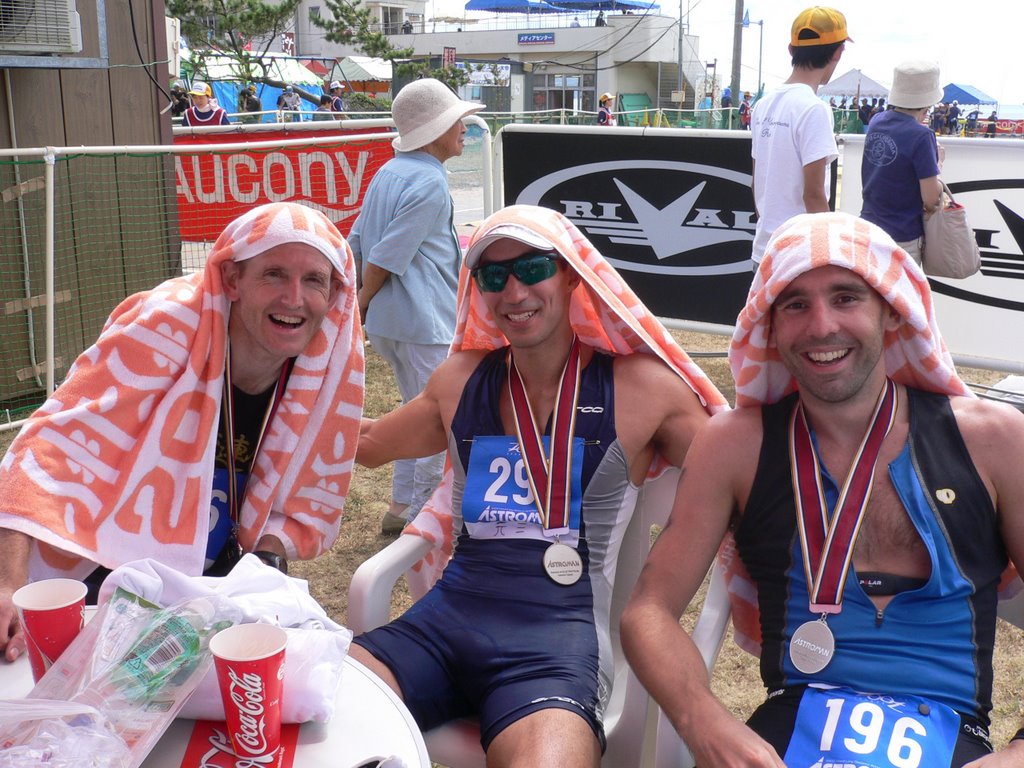
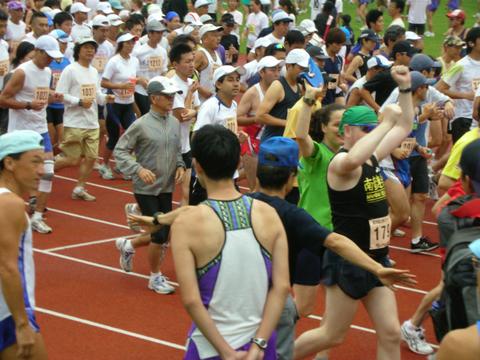
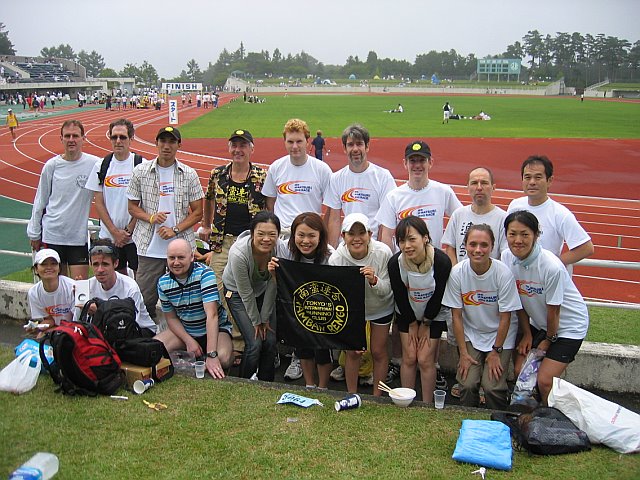
Now after all this seemingly negative talk, I should point out that I perceive the glass as being more than half full. The Edogawa event was a fine day. 25 teammates participated, 7 of them achieving personal bests. Everyone seemed to have a good time and I was glad to have played a small role in promoting the event. Moreover I managed to finish 8th in my age division and it was gratifying that I could be in the award ceremony at all given my low mileage training. (The Edogawa 10k award ceremony is a remarkable event in itself with the pageantry and ritual one would expect at the crowning of a new Roman Catholic Pope or Olympic opening ceremony).


Clearly cross-training allows me to maintain overall fitness. I know from past experience if I had not been doing the swimming and biking these past few months (or did nothing for more than 3 weeks) I would have been light years farther back.

Friday, October 13, 2006

Visit to Nike World HQ

I like to consider myself a loyal and devoted Asics person. But yesterday I found myself at Death Star, the Nike World Campus in Beaverton Oregon.

Years ago, when I was growing up in nearby Seattle and Nike was a small renegade company I was the company's biggest fan, and wore the original Pegasus, Equator, Cortez, and Waffle racer. But over the years the company's emphasis on marketing over product development, the ubiquity of the produce (12 million shoes sold last year in Japan alone), and the general arrogance of the Nike brand image has turned me anti-Nike. Especially after learning how Nike got its start by stealing Asic's product design, patenting the design in the US, and then turning around and filing a lawsuit against Asics.

Despite these strong feelings, I am willing to sell out on my beliefs at a cheap price -- 50% employee discount on the new Nike Air Equalon at the Nike Employee Store.

I must admit the Equalon's feel pretty good. I went for a test run around the Nike campus. The Nike campus is a pretty competitive corporate jogging trail. I was running at a reasonably good pace, but two female MBA-type marketing staff overtook me by the Alberto Salazar building.

The Nike workplace is amazing with a soft woodchip running trail meandering around the 178 acre site. The campus has an artificial lake at its center surrounded by buildings named after Nike athletes like Lance Armstrong, Mia Hamm etc. At the entrance is a museum with Steve Prefontaine's old shoes and jersey.

Of course I hope to get Ascis (or if necessary Saucony or Adidas) for my next racing flats.

Saturday, October 07, 2006

Minimalist Run Training - Running two days per week


Thousands of runners (mostly lazy Americans) have completed a marathon based on a training regime of only three runs per week.   The serious runners in my Tokyo running team are appalled to hear of such half-hearted devotion to the sport.

As I start preparing for the fall race campaign I am doing even less than that.  Over the past several months my run training is down to only TWO workouts per week. 

Here is my recent weekly mileage (in kilometers, not miles)

July 30 - 8/5   - 26
Aug 6 -12      -  31
Aug 13-19     -  34
Aug 20-26     -  29   
Aug 27 -9/2   -  19    (Sado taper)
Sept 3-9       -   37   (Sado Triathlon)
Sept 10-16   -   17
Sept 17-23   -   28
Sept 24-30   -   18

Granted each week I am also doing 2-3 one-hour swim sessions and 1-3 bike rides/spin sessions.  This cross-training has so far allowed me to maintain a reasonably competitive level of speed and endurance . 
 
However as I struggled to run 6 x 1000 meters on Wednesday at a 3:22 average, I begun to wonder if the limited running is starting to have a negative impact on me.   
 

Monday, October 02, 2006

My top ten list of Japan running events

Here is quick ranking of my favorite running races in Japan. The reality is that I have only participated in perhaps 20-25 of the hundreds of events in Japan, so maybe the point I am trying to make is my need to get out more. This list is only composed of 5k to half-marathon distances (no ekidens, marathons or triathlons). Since all Japanese races are efficiently organized, race organization is less of a factor. Unique, scenic courses are the key criteria in this list:


1. Ohyama Tozan -
Upside - Unique challenging all uphill course. Great backpack given to all finishers. Convenient. Scenic. Crowd support.
Downside - All uphill. Finish is painful.


2. Kyoto Half-Marathon -
Upside - Its Kyoto - scenic course and good excuse for Shinkansen trip. Flat and fast.
Downside - Crowded. Expensive. Must register 4 months before race.


3. Montrail Ome 30k Trail Run -
Upside - Scenic forest trail. Cool Shinto ceremony in middle of race. Day of race entry Hilly.
Downside - Expensive. Hilly.


4. Fukuoka City Half-Marathon -
Upside - Good excuse for trip to Fukuoka. Cool stadium finish.
Downside - Much of course is through industrial area. Wind.


5. Edogawa -
Upside - 15 minutes from Tokyo station. Lots of Nambanners. Elaborate award ceremony. El Torrito.
Downside - Average scenery. U-turns and potential wind. El Torrito.


6. Ohtawara (10k)
Upside - Flat. Fast. Ryokan. Lots of Nambanners. Watching marathon before and after 10k.
Downside - Event held on midweek holiday. Not particularly scenic.


7. TELL Race -
Upside - Lots of prizes. Convenient. Day-of-race registration. Efficient charitable use of entry fee. Bob is in charge. Good t-shirt.
Downside - Just another run around Palace (where I frequently train).


8. Obuse Half-Marathon
Upside - Ryokan after the race. Playing in fountains at finish. Bands along the course.
Downside - Hot and humid. Lots of turns. Expensive and inconvenient from Tokyo.


9. Tachikawa Showa Kinen 10k
Upside - Flat. Fast. Competitive. Reasonably convenient. Race entirely in large, pleasant park.
Downside - Two loop course. Slightly expensive.


10. Fuji-Yoshida
Upside - Barbecue before race. Scenic weekend trip.
Downside - Running after barbecue. Inconvenient. Long downhill run section on pavement.

Sunday, September 24, 2006

Off-season triathlon training


Theoretically now my triathlon "season" is over. I was told that with the Sado Island Triathlon behind me, it is time to hibernate and fatten up over the winter. At Oi-futo two weeks ago, my teammate Mary said I looked tired and should get some recovery

But I hate to lose my momentum and training base, and with the end of summer the days are clear and cool, and I want to go outside and bike and run. The seasons here are not like my hometown of Seattle where summer is warm and dry and winter is cold and wet. I am starting to ponder triathlons and running events in the December timeframe (Phuket, Angkor Wat) which sound like great fun. So these past few weeks is really more of a "transition phase".

According to the research my off-season transition phase can be any duration more than 2 weeks. Anything shorter than 2 weeks will not produce the necessary physical and mental regeneration. The transition phase should incorporate the following --
1. Rest - At least 2 days per week
2. Weight training
3. Swim drills
4. Intensity - RPE (rate of perceived exertion) of 3 to 5 (on a scale of 1 to 10).
5. Duration - From 30 to 75 minutes each workout session.

I have had no problem resting 3 days per week. The weight training is a bit harder, since my spa is mostly about soaking in baths rather than pumping iron. I really never do weight training, though I know it is valuable for triathlon training (and long-term health). At least we are doing some focused strength work at Yoga for Athletes.

All my workouts these past three weeks have been low intensity except for the 10x800 Yasso track workout last Wednesday night where Namban teammate Omar pulled me along at 2:40 pace. As far as duration, my swims have dropped down to 35-minute sessions, and my boring indoor bike sessions have been only 55 minutes.

This weekend marks 3 weeks of "transition" and I am starting to plot my "base training".

Tuesday, September 19, 2006

Run for Africa Race Volunteer

I served as a volunteer "sweeper" Sunday at the 3rd Run for Africa 5k&10k runs -- running behind the last runner and making sure no one is lost and abandoned somewhere out on the run course. I was pleased to be able to again help Taro and his Harriers team and his cause - an orphanage in Zambia.

Over the past two weeks I have received at least a half-dozen announcements of upcoming charity running events here in Tokyo - Terry Fox Run, Tyler Foundation, Run for the Cure, Run for Hunger... While the US endurance event calendar is dominated by charity events, it seems that most Japanese events are sponsored by local government recreation department bureaucrats. The Japanese bureaucrats always do a good job in their diligent and conscientious way, but I think the US charity/corporate sponsor model delivers more for the money and effort. So this sudden proliferation of charity runs strikes me as a good thing.

I have a bit of background in the world of philanthropy having established IRS 501(c)3 non-profits in Nevada and Hawaii, co-founded a micocredit lender in Central America, worked at the Low Income Housing Fund in San Francisco, orchestrated a $3 million Intuit software donation in Southeast Asia, .. I like to think this effort has made some positive difference, but to be honest, my exposure to the non-profit world has left me a bit cynical. I always struggled with feeling that there was too much focus on fundraising and internal politics, and too little donations reached the actual program.


The best events are when the run itself is a meaningful statement. Juergen Wittstock and I helped to launch the Save Mount Takao Run two years ago - an event protesting the construction of a redundant highway through a treasured wilderness area. After paying for marketing, timing devices, postcards, etc. surprisingly little of the money raised went to the environmental group programs. But the very fact that hundreds of people showed up was a statement to the highway authorities. Moreover after the race, the runners wore the Save Takao t-shirt, and the participants all heard the Save Takao message and were able to see and experience the threatened area first-hand.

Also when the cause is personally meaningful, doing a grueling endurance event and raising money provides a sense of empowerment. For example, a few years ago in San Francisco back when people felt helpless in the face of AIDS, pushing themselves through the 500-mile AIDS bicycle ride gave them a sense that they were personally helping to accomplish something for people they care about. So I guess I need to find an event raising money for ulcerative colitis

I am convinced the community here would embrace the "Team in Training" concept. I know several close friends in California who gushed about the life transforming nature of the experience. The Team in Training participants at the Wildflower triathlon had more enthusiasm and camaraderie than even high school kids, singing and crying and rooting each other on. I have pondered how to modify this concept here, but to do it right would require large-investment of full-time staff and corporate sponsors.


So for now I will simply find sponsors and start training for one of the small local charity runs -- like World Run Day or Run for Mika.

Sunday, September 17, 2006

Paying Top Dollar for Punishment, 26 Miles' Worth


The serious runners of Japan are in a frenzy this week over the news that some 75,000-plus individuals have entered into a lottery for the 30,000 spots in next February's Tokyo Marathon.  75,000 is quite a large number given that this is the very first time the event is being held, there has been little  overseas marketing, and several runners I talked with were put off by the US$100 entry fee.   Clearly there is  significant pent-up demand.  Teammates on the Namban Rengo mailing list are asking how to improve their chances of getting one of the coveted spots in the marathon.

According to yesterday's NYTimes article (copied below)   New Yorkers have resorted to extreme measures to  participate in the New York Marathon, including  creating counterfeit race numbers and  buying race numbers online.   NY Marathon race numbers have reportedly been sold on eBay for $450.   In marathon-mad Tokyo, race numbers could conceivably be bid up even higher than that. 

But to a triathlete this is small change.  I considered entering last years Arizona Ironman, but it would have cost me a $500 plus a $2,500 donation to charity.   A spot in the Kona Ironman was purchased for over $30,000 on eBay.   When I registered for California 's Wildflower triathlon, I sat poised at my computer at midnight on the day of registration and managed to get one of the 2,000 spots, all of which sold out within a few hours.

I hope to win one of the treasured spots in February's Tokyo Marathon.  But I don't plan to go to such great lengths to enter the marathon.  26 miles is a lot of punishment.


September 16, 2006

Paying Top Dollar for Punishment, 26 Miles' Worth

The notion of paying hundreds of dollars for the opportunity to run 26.2 miles may not appeal to most people, but some runners are doing just that because demand for marathons has outstripped the number of spots available in the fields.

More than 100,000 runners are training now for the three major fall marathons — Berlin, Chicago and New York City — and many thousands more are preparing for smaller races throughout the country. But many runners were unable to gain entry into the race of their choice, and some of them will turn to prohibited means of getting into the field, like using counterfeit bibs — the paper numbers runners wear on their shirts — or buying bibs at a premium online.

Race organizers say they are frustrated by this unintended consequence of staging popular events, but there is little they can do. Photocopied or otherwise fabricated bibs are needles in a haystack of tens of thousands of runners.

More than 90,000 people entered a lottery for the 50,000 spots awarded for the New York City Marathon, which will be Nov. 5. Considering that thousands of runners do not make it to race day because of injuries and myriad other reasons, organizers expect the field to be about 36,000.

A 26-year-old woman who did not receive a spot in last year's New York City Marathon said she photocopied her mother's bib in order to run.

The woman, who requested anonymity for fear of being barred from future races, said she had looked at the classified ads on the Web site Craigslist.

She said prices online were too high, and one seller backed out of the deal after having second thoughts. A co-worker suggested something that had worked for him five times — creating a homemade bib.

"I never ended up having any problems," she said.

Neither did her co-worker, who also requested anonymity. With the help of a graphic designer, he altered and copied an official bib to make one for himself and five friends. "He'd turn a 3 into an 8 or a 7 into a 1," he said about the designer. "That way we could all run together without getting caught."

He said he was not concerned about being caught. "They're not checking very hard," he said. "It's not like airport security out there."

Organizers of the New York City and Chicago Marathons agreed that photocopying bibs was a problem, but they said that catching people who did that was not their priority.

"When there's demand, you see creativity," said Carey Pinkowski, director of the Chicago Marathon. "That's just how it is, and there's not much you can do about it."

Of more importance, organizers say, is the growing number of people offering bibs for sale, sometimes at five times or more above cost.

A New York City Marathon bib was offered on eBay last month for $750 with a "buy it now" option of $1,000. It went unsold, but two weeks later another sold for more than $450. Among the marathon bibs for sale on eBay yesterday was one for Chicago with a bid of $162. Most bibs for the New York City Marathon are selling for $100 to $200, but one seller on Craigslist was recently asking $775 for his bib for a man in his racing age group. People placing ads looking for bibs were offering up to $300.

The entry fee for the New York City Marathon is $80 for members of the New York Road Runners Cluband $107 for nonmembers plus a $9 nonrefundable processing fee. The Chicago and Boston Marathons filled their slots in record time. Chicago's fee is $90. Boston, which requires runners to meet a qualifying standard, charges $95 for Americans.

Another woman who was not successful in the lottery for New York posted an ad on Craigslist for a bib so she could run with her friends. She said she was willing to pay as much as $200. "I definitely wouldn't pay what other people are paying on eBay," said the woman, who also requested anonymity because she feared race organizers would bar her from future races.

With few exceptions, marathons prohibit the transfer of bibs because of the medical issues that can arise if an injured runner is misidentified, and because of the desire to preserve what they consider a fair entry system. Many organizers said they were taking steps to curb online sales.

Richard Finn, a spokesman for the New York Road Runners, which organizes the New York City Marathon, said two volunteers monitored Web sites to see if anyone was selling bibs. The directors of the Chicago and Boston Marathons said they also tracked sales online.

According to Mary Wittenberg, the director of the New York City Marathon, about 100 runners were contacted and warned each year for trying to sell numbers. She said 25 people had been contacted this year.

But catching someone may be a difficult proposition. People selling their bibs online usually do not reveal their identity or bib number. And many recreational runners figure they will blend into the crowd of thousands without being detected.

But sometimes runners do better than expected. In the 2001 Vermont City Marathon, in Burlington, the women's second-place finisher, Karine Maltis of Montreal, confessed that she was running under someone else's name. Based on her previous time, Maltis did not think she would come close to first place. Race organizers said she was wearing a counterfeit bib, and she was stripped of her medal and $800 prize money. The woman who sold her the bib number, Johanne Provencher, was barred from the race for life.

The year before, the men's eighth-place finisher, Joe Straub of Chester, N.Y., was caught running under someone else's name. He and the seller were also permanently barred from the race.

Pinkowski acknowledged that it was impossible to catch every swapper. "We require everyone to provide identification when they pick up their bibs, but you're never going to stop it, obviously," he said.

Susan MacTavish Best, a spokeswoman for Craigslist, said in an e-mail message that the company had not been contacted by any marathon organizers, but that it would work with them if the seller had signed a contract not to resell the bib. She noted that the site was also self-policing; users can flag posts they find inappropriate.

Many marathons employ deferment policies that allow runners to drop out of a race and have a guaranteed spot the next year. The New York City Marathon permits runners to do so up to 24 hours before the race. But under no circumstances do those runners receive refunds, which is the problem for many of the runners who resort to selling online.

Dave Dannenberg, 36, who was registered to run in the Marine Corps Marathon in the Washington area, sold his bib on eBay after he injured his ankle. "I just didn't want to waste the money I spent when I registered," he said.

Greg Golightly, 35, injured his foot and is not permitted to transfer the bib he bought for the Twin Cities Marathon.

"It's a tough situation," he said. "You register seven months in advance. It's tough to gauge where you're going to be."

The Marine Corps and the Vermont City Marathons have introduced transfer policies in recent years, whereby the buyer and seller arrange the transfer on their own terms, then a fee is paid to the marathon. The organizers encourage sellers to sell their bibs at cost. The result has been more runners at the starting line on race day.

Increased turnout, however, is not necessarily a good thing for marathon organizers, who account for a certain number of dropouts when determining how many runners they will allow in the field. Compared with New York's 36,000, about 34,000 ran in Chicago last year.

"That's a number we feel comfortable with," Pinkowski said. He said he had no desire to make the field bigger. Wittenberg and Jack Fleming, the spokesman for the Boston Marathon, also said they were not considering transfer policies.

The sheer number of entries also makes transfer policies unattractive. Preparing the packets that runners receive upon registration can be daunting. "It's a logistical challenge for us, transferring the bibs and the chips," Pinkowski said, referring to the computerized timing devices that runners wear on their shoes and which enable race organizers to identify them.

Meanwhile, the online marketplace for marathon bibs may continue to expand, even though runners competing under someone else's name are not recognized in the official results.

"I would think that would be a hollow victory," Pinkowski said.


.

Friday, September 08, 2006

Sado Astroman II

Since my triumphant Sado experience I have been pondering how Sunday's time compares to my two previous half-ironman distance triathlons. With triathlons one is comparing apples and oranges, but it certainly appears that I have improved in all 3 areas:


Sado Astroman (September 2006)
2k swim 41:32
105k bike 3:28:43
20k run 1:28:49
Total time 5:39:04


New Zealand IM (March 2006)
3.8k swim cancelled
90k bike 3:14:34:
21.1k run 1:37:44

Wildflower California (May 2002)
1.9k swim 47:29
90k bike 3:29:00
21.1k run 1:58:19
Total time 6:14:48

Key elements -
1. Heat - I am still obsessed over this factor. Would our times have been faster if it was 10 degrees C lower? I have to think so - at least a little bit for Adam York and I. In any case it certainly would have been more pleasant run if it was cooler.

2. Wind: The wind seemed to be very much in our favor on Sunday with a bit of a tailwind on the coast. Usually we finish a triathlon and whine and moan about how the wind was always blowing against you (in seemingly every direction). I can't be confident of having such favorable wind in future events. In comparing to my New Zealand time I have to factor in how the wind was a huge negative factor.

3. Elevation: One big hill on last third of bike certainly slowed us down. My rough bike spits
First 35k - 1 hour
Second 35k - 1 hour
Final 35k - 1:26 hours
The final 10k included some tight streets and I switched to lighter gear to prepare legs for run.

4. Training - I seemed to have enough endurance for the five hour Sado event, in spite of uneven training. Some of the residual benefit of last Spring's training must have lasted until Sunday. I didn't do many brick workouts and longer runs over the summer. Perhaps that would have helped a bit on Sunday.

5. Fatigue from bike on the run - Compared to running a 3:32 marathon at Ironman Japan (and walking every 5 minutes), running a 1:28:49 seems a bit weaker, and my relative competitive position on the run was worse at Sado. Still it seems apparent that pushing harder on the bike is well worth any dropoff on the run time.

6. Eating - More seems to be better. My slow Wildflower time may have largely been lack of fuel. I struggled to eat on Sunday, but I think the big breakfast, and the 3 gels, 2 bananas, and the powerbar were just enough to get me through Sado.

7. Effort - Based on my collapse at the end, I feel that "I left it all out there" as had been my plan. Of course it could be that I was just being a wimp at the end.

Wednesday, September 06, 2006

Sado Astroman Triathlon


The Sado Astroman Triathlon this past Sunday was great fun, and arguably my best triathlon performance to date. My swim and bike were strong and I manged to hang on and survive the run. I finished in 5:39:04 which was good for 58th out of 522 men, and 8th out of 102 in my age group.

The rather odd Astroman tagline warned us that "it will be the longest day of your life" and sure enough at 3:50am on race morning the ancient proprietress at our creaky ryokan walked all the way into our room, stood above us and in a high-pitched chirp announced "Asa gohan dekimashita....doozooo." Keren, David and I grumbled and tried to go back to sleep, but soon we found ourself in the dining area eating another huge meal of fish, vegetables and rice - not my typical breakfast of cereal and yogurt and fruit, but I wasn't complaining. I wasn"t complaining because compared to poor Keren, my stomach was doing fine. Keren had been suffering with a horrendous digestive problems from his trip in India. I reassured him that once the gun goes off he will be fine, but given the way he sounded in the bathroom I really had to secretly agree with him that he was doomed.

Swim
It was a gorgeous morning and the water was calm and clear and inviting.
In the past I have hung at the back when the race starts to avoid the frenzied crowd. But I hoped to stay near Dave, who in turn hoped to stay near Keren, who in turn hoped to stay close to Adam, so when the gun went off and Adam went out fast, we all went out fast. Moreover we have spent time this summer practicing "porpoising" (repeatedly diving forward in shallow water) and it proved so successful that by the time we got to deeper water and I started to crawl stroke I was toward the front of some 500+ swimmers. Problem was that soon a pack of 100 swimmers literally swam over me. The first half of the swim was pretty rough, but I managed to get in a decent rhythm on the return stretch and when I got out of the water my time of 41:32 was close to my most optimistic goal, and certainly my best triathlon swim ever.

Bike
The 105-kilometer bike route around the southern section of Sado was spectacular. First we rode through rice fields in the middle of the island, then we began a clockwise loop around the mountain hugging the rocky coastline. I worked on staying with cyclists who passed me and averaged over 35-kilometers per hour along the rolling hills, a much faster pace than what I rode at Ironman Japan in May. The drafting rule at Sado Astroman is less strict than at Ironman races and I tried to maintain a few bike lengths behind any cyclist in front of mine but always have someone within 10-20 meters to at least psychologically pull me along.
I was startled to pass Keren at around the halfway mark, not recognizing him until he shouted my name. Obviously Keren's stomach problems were taking a toll on him, but triathlon is a merciless sport, and I continued to chase the pack I had been riding with.
Around 80-kilometers the course took us up a long hill which slowed my pace, but allowed me get up out of my saddle and to pass other cyclists. The final downhill section of the course was exhilarating - I sang at the top of my lungs as we raced back down along the coastline into town.

Run
Of course then after all the glorious pleasure of cycling, the run was agony from the start. An hour and a half of pure hell - certainly among the most difficult 90-minutes in my life. The first 5 kilometers running out of town were tolerable, but the next 5k took us out into the rice fields with the sun beating down and several long gradual uphills. I was feeling discouraged by fact I was not moving past people as quickly as I usually do during the run portion of a triathlon. It seemed like I was hardly moving as I trudged along and was relieved at the kilometer markers that I wasn't doing quite so bad as I felt (4:04 per kilometer pace for the first 5k, 45 minutes at 10k). When I slowed down for coke and sports drink at the 8-kilometer aid station I completely cramped up and was forced to stop and stretch.

I believe the important thing in the sport is challenging yourself against the clock and your own potential. But in the pain and the mind-numbing heat of Sunday's run, one thought dominated my conscious -- catching up to Dave. The course is an out-and-back with the turnaround exactly at 10-kilometers, so at that point I could see that I was 3 minutes behind Adam and 1:30 behind Dave. Without this motivation I might have just found some shade and taken a nap and waited for evening to finish. But I knew that since running is my strength I am supposed to be able to make up distance on people during the run. This sense of competitiveness was amplified by the fact that each of the three times I passed Keren (during the bike, as he came in on the finish of this bike, and on the run loop) he shouted out how far I was behind Dave and how I needed to hurry up.. I caught up with Adam in the heat and we commiserated about our hatred of hot weather. Then I started trying to chase down Dave and for at least two agonizing kilometers I could see his blue jersey a few hundred meters ahead of me. "What took you so long to catch me" Dave asked when I finally ran up alongside him at around 18k. I could barely answer since I was breathing too hard. I pushed ahead to finish the run in 1:28:49

I had another inauspicious finish (like ironman), cramping up again after crossing the finish tape and being dragged off to the ice/salt bath. I had hoped to cheer on Dave and Adam, but it took me too long to get back on my feet and limp over to the finish chute.

I would certainly recommend the Sado Island event to other triathletes. It is a scenic course, a well-organized event, and a nice island excursion from Tokyo. For beginner triathletes there is a generous cutoff and a friendly crowd to cheer people on who were still finishing the 127-kilometer course at 6pm, 11 hours after the event start.

Friday, September 01, 2006

Fuji-Yoshida 10k

It is all a matter of mental mindset going into an event. This past weekend at Fuji-Yoshida I was mentally prepared for a relatively easy tempo run. But the course was all uphill for the first 5k and all downhill for the last 5k. Now if I had planned on working through a long up and down course I would have been fine.

Back in October of 2004, amidst the painful recovery from the absurdly hilly Takao Trail Run, when Keren Miers first recommended the Fuji-Yoshida Fire Festival. Keren painted a vision of milk and honey - runners happily frolicking up and down gentle inclines through a thick, fragrant forest of pine and cedar trees nestled at the base of Mount Fuji.

And though it was a scenic and fun course, the happy frolic turned into one of those painful death slogs for me. My struggle was also because I went out too fast. I had told Adam moments before the starting gun that my enjoyment of the race is inversely correlated with the speed of my first kilometer, but somehow I ignored my own advice - something inherent in starting on a track heightens my sense of competitiveness. Moreover I had not figured on such a long climb - a steady uphill for the first half of the run and then a hard downhill from 5k to 7.5k and again at 9k.
My splits -
First 5k - 20:19
Second 5k - 18:02
Even with the faster second 5k it seemed like half of the runners in Japan passed me on the long downhill. The course was an interesting challenge, though I wish I had been better mentally prepared for the uphill.


Protein loading
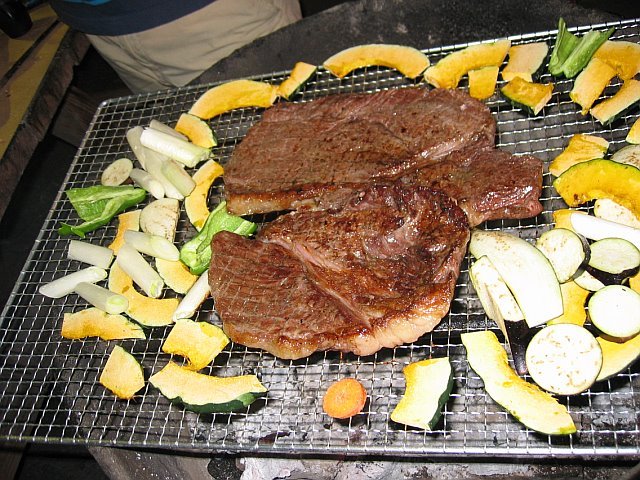
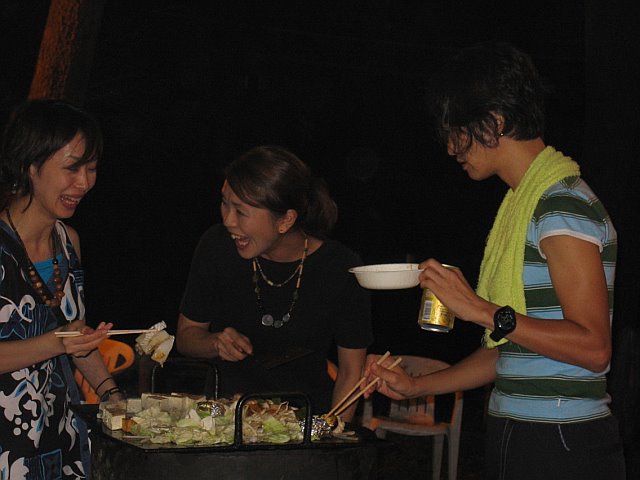
Of course Fuji-Yoshida was not so much about the run - it was about the barbecue - a staggering array of meat and vegetables. As expected Namban's Australian runners (Colin, Steve) lived up to the stereotype of a nation of barbecue aficionados. The concept of a team barbecue proved popular. I have found that invariably in Japan when going out with a group we eat in restaurants rather than at barbecue picnics or dinner parties. So barbecuing was rather novel and most people ate and drank to excess.

The majority of my athletic endeavours this year have been triathlons at which I eat like crazy before, during and after the event. I seem to have forgotten that in a running race of a distant like 10k I feel much better when I hardly eat anything at all for many hours before the run.

So you might naturally ask at this point whether it would be more logical to have a big feast AFTER a running race rather than before. Well, yes, likely the race performance would benefit. However we consistently find that the team is simply too tired to prop themselves up for a big dinner after a hard race, let alone have the energy to prepare a barbecue. Very often one contemplates all the great things one will eat and drink after a triathlon. But then after hours and hours of eating gel and sports drinks in the hot sun your digestive system is so trashed that all you can do is sip the soup you are handed at the finish line aid station.

Perhaps Keren and Stu have the best strategy for post-race dinner - they make a point of staying at the Grand Hyatt whenever they do triathlons, and after the race they simply call down for room service.

Thursday, August 24, 2006

Sado Triathlon - Too much training too late?


Challenge yourself to the hardest rase. You'll have the longest day of your life. but you'll meet great Volunteers who will support you in the rase.
- Sado Triathlon Inspirational Motto


So with the Sado half-ironman looming on September 3rd I feel compelled to suddenly start training. After weeks of not riding at all, since August 1st I have ridden close to 600 kilometers. During each of the past two weeks I have put in 15-hours of combined bike, run and swim training.

It is not at all clear that this burst of training will help my performance at Sado. For that matter it may cause me to be more tired at the event. The literature on triathlon training generally recommends a series of hard weeks and rest weeks over the course of several months, and then a 3-4 week taper.

But my training has long been a function of how much time I find that I have to train, and what I simply feel would be most enjoyable to do on that particular day. In the past few weeks a whole community of cyclists have emerged to ride with at Oi-futo -- Mary, Chuck, Motozo, Chris, Keren, Joe -- and I have been inspired to ride again. Instead of a lonely mind-numbingly boring ride around and around a bleak, industrial wasteland, the Sunday morning ride is now a festive party. The Wednesday night track workout has always been a festive party, and lately even more so with over 30-40 people enjoying the intervals together.

Of course with 10 days to go to Sado I could start tapering now, but this weekend is the most festive party of the late summer -- the all-important Fuji-Yoshida Fire Festival 10k


Thursday, August 17, 2006

Coffee Blog - All coffee, all the time

Greater Perrinville's worldwide audience continue to report that they are sick and tired of my whining about cycling in hot weather and my running injuries, and that they want to hear more about the thing that obviously matters most and appears to have the greatest impact on my triathlon performance -- drinking coffee.


Today's NY Times reports even more benefits from drinking coffee -- a review of studies by American Medical Association found strong evidence that habitual coffee drinking reduced risk of serious ailments including heart disease, diabetes, and liver cirrhosis by releasing antioxidants which help control cell damage. I had been trying to consume more grape juice and blueberries for these healthy antioxidants, but the latest studies show that coffee is actually a better source of antioxidants. This report comes on top of the earlier research I discussed which showed that coffee helps performance in endurance events.


Needless to say I was delighted to read this, and immediately began increasing my coffee consumption. Before I finished reading the article this morning, I began brewing a jumbo, American-sized pot of Peet's Las Hermanas blend coffee

The coffee tastes excellent and I was able to help to empower the women of Nicaragua in building an environmentally sustainable community as well as improve my long-term health situation

As I write this I am drinking an enormous Segafredo latte. No research as of yet on whether the chocolate cream cookies that I am eating with the latte is actually good for me, but I am figuring it is just a matter of time until scientists report that cookie consumption is correlated with longevity, so I am going to eat the whole package..

Thursday, August 10, 2006

Yasso 800


Last night at Oda Field the group ran the Yasso 800 workout

The idea of the Yasso 800 is that the average time of ten 800-meter intervals in minutes and seconds will predict one's marathon time (in hours and minutes). 

So last night I ran an average 800-meter time of 2:38, implying I am capable of a 2 hour and 38 minute marathon. 

The key point here is that this projection only suggests a theoretical capability.  Since I could barely run 14-kilometers on the weekend, it is highly questionable whether I could run a marathon at all right now, let alone complete one in a time of 2:38

Nonetheless it was an encouraging workout, and certainly among the most grueling I have done in months.   I ran with Omar and Taro, and when Omar took us through the first 800 in 2:35, I knew it was going to be a struggle.   An added challenge comes from needing to complete a 400-meter jog between the intervals in the same time interval that we run the 800s, so 2:38 in my case.   My the end of the 12-kilometer I was drenched in sweat and struggled to  find energy to shower and make it to the post-run dinner.

Monday, August 07, 2006

Back on the bike


It begins to dawn on me that I only have a bit over a month to prepare for the Sado Island Astroman Triathlon on September 3rd and that based on my current training I am absolutely doomed.  Cycling was my weakness at Japan Ironman, so what do I do to prepare for the next event?  I stop cycling completely (except for a few spin sessions).  Not only do I risk an even more embarrassingly slow cycling time - I risk being so exhausted after the ride that I lack leg strength on the run.

My most recent excuse for not riding, on top of risk of vehicular collision, rainy weather, hot weather, lack of 4-hour time blocks, lack of medical insurance.. (it is really remarkable how many excuses I dream up for not riding) is that my headset has been damaged - the ball bearings were crushed and the ring worn out.   Naturally I couldn't figure out what was wrong with my bike (I can barely figure out when I have a flat tire), but the surprising thing in this case is that the bicycle shop couldn't seem to figure it out either.   The bike shop had my bike for weeks and told me it was repaired when in fact it was not.  Naturally they were very apologetic when they finally fixed it last week and they did not charge me for any labor costs.   I was pretty relaxed about the whole matter - lets face it, I was lazy about riding anyway.

So finally this week, despite all my moaning in earlier blogs about my aversion to hot weather, and my concern that triathlon training is bad for my health, I push outside my comfort zone and get on my bike and ride 80 kilometers around Tokyo's 9-kilometer Oi-futo loop.  For awhile I felt pretty good - maintaining a speed over 30k per hour and keeping up with some of the packs of hardcore cyclists.  This  lasts for a couple hours before I begin to fade badly, and the ride home is misery.  Worse yet is how I feel on my long run later in the day.  My "long run" is about 14-kilometers.  I am aware that some people might not consider 14-kilometers to be a long run.  But for me right now 14-kilometres is much farther than most of my runs, and after the bike ride, the 14-kilometers seem to last forever. 

Monday, July 31, 2006

Unhealthy lifestyle

I attend Yoga for Triathletes again Saturday, and the more I hear our yoga instructor, Michael Glenn, talk about endurance training, the more swimming, cycling and running seem akin to smoking, drinking, and eating chocolate swirl ice cream. Rather than healthy lifestyle activities, apparently swimming, cycling and running are sinful indulgences that will wreak havoc on my lower back, quads, shoulders, etc.

This comes on top of my teammate Anthony Zeller explaining to me his hypothesis that the human body has an optimal capacity of 25,000 miles and just like a car, once you click past that point it is all downhill with lots of time in the repair shop.

Now I am regretting my misspent youth. I guess I shouldn't have squandered my 20s and 30s on those wasteful long, easy runs. Perhaps I should have played pool or darts or just drank, and then I could look forward to running along the beach in my twilight years and winning the over-80 age group.

Oh well, at least at least lately I have been making the most of my remaining miles and keep my back intact by emphasizing quality over quantity.

As noted in my blog post on Saturday (my quarterly training review), my training totals the last three months have been relatively low - only 30-40 kilometers per week of running. These limited workouts are mostly either interval work, long runs or tempo runs.

For example, two weeks ago Wednesday I did a ladder workout on the track with Namban Rengo and managed to hang on and run 3:50 for 1200, and 5:12 for 1600. Then at a 5k time trial last Wednesday I managed a time of 17:31 (despite running the first 800 in a ridiculously fast 2:32). This time is still somewhat feeble, but it is my benchmark for now, and if people ask me my 5k PB I will tell them I ran 17:31 in July 2006.