Monday, January 15, 2007

Winter 2006-07: Trail run series Part 2

My primary training goal has been to avoid running the same weekly long course twice, and to continually discover new and entertaining courses. Continuing my November 25 blog posting, here is a list of my long runs over the past 6 weeks --

Week 7 (December 9) Olomana Trail 12k
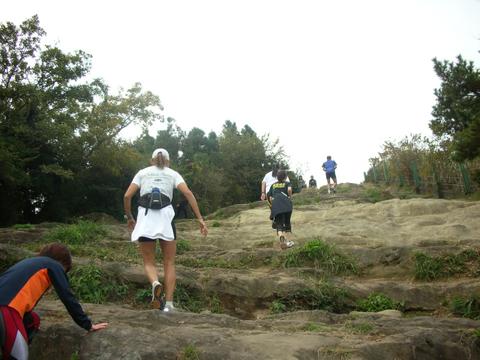
My trail "run" near where I am staying in Kailua, Hawaii turns into a steep and slightly perilous climb along a narrow ridge. I manage about 6k of running up roads and mountain trails before I find myself walking, then crawling, then pretty much just clinging to the rock thinking about how stupid it will look if I fall and hurt myself after breaking all the common sense hiking rules -- hiking with other people, telling someone else where you will be hiking, bringing first aid equipment, etc. (well this was supposed to be a run not a "hike" anyway). Somehow I will myself to turn back and clamber down and after the "run" I look a the hiking trail guidebook afterwards and under danger level the Olomana Trail is "Very High"


Week 8 (December 17) Angkor Wat Half Marathon 21k
Needless to say this is an interesting new course - see December 25 posting

Week 9 (December 24) Sagamiko to Jimba to Takao
The Takao Mountain area is among the most popular day hike destinations for the 30 million odd people living in the Greater Tokyo area thanks to its easy access and extensive network of trails. Fortunately (for us runners) 98% of the hikers stick to the area around the Takaosanguchi station and Takao summit which is hardly a nature experience - lots of pavement, packs of schoolchildren, numerous vending machines, a cable car, noodle stands, etc. After running various routes through the Takao area, and after much discussion and analysis, I have concluded that the optimal run in terms of : 1) Time Efficiency, 2) Percentage of run on soft trail, 3) Fewest hikers, and 4) Scenery, is to start at Sagamiko station, run to the top of Jimba Mountain, then run back to finish at Takaosanguchi. This route is even more ideal if you take the comfortable weekend Kawaguchiko Express to Sagamiko. Since this run starts at one train station and finishes at another station, ideally the runner should carry everything with them. This proves no problem for me, for a run like this I will simply carry
1. the running gear I wear
2. a watch
3. a change of shorts
4. a train pass
5. a 1000 yen note,
6. and a Power Bar.
I send a message to the Namban Club email list about the run, and amazingly 15 people join me at Sagamiko. Actually the amazing thing to me is how much stuff everyone else brings. What is all this stuff they carry I wonder - Storm clothes? I-Pods? Navigation technology? Communication technology? Tents? Stoves?
It is a great day - if you look very, very closely in the accompanying picture you can even see Mount Fuji


Week 10 (December 30) The Kamakura Trail Run - 30k
Over the years I have always made an effort to time my runs around sunset. Research shows that this is the best time for your body to exercise, and of course it is the most pleasant and scenic time of day (no matter what my masochist teammates might lecture about their disciplined early morning runs). And naturally I make particular effort if I am running by a beach at sunset. So when 16 runners join me for the loop of Kamakura I time the run so you can see Mount Fuji silhouetted on the skyline as we run along the long stretch of coastline from Imamuragasaki to Zushi Marina, and Japan's Beverly Hills:


Week 11 (January 7) - Ikejiri to Inokashira Trail - 32k
This is an urban trail - a 32 km out-and back course starting in Ikejiri-Ohashi, following streams, walking paths, playgrounds and urban pocket parks from bustling Ikejiri-Ohashi all the way out to the bucolic Inokashira park in Tokyo's upscale west suburbs. Brett Larner managed to piece together this course by combining various trails into an almost continuous, seamless link. A nice urban adventure - at a brisk 4:45 per kilometer clip.


Week 12 (January 13) - Musashi Itsukaichi to Mount Hinode - 20k
My teammates advise me to focus on marathon training. They are so earnest and emphatic - it is inspiring, even touching. But for so long I have heard rumours about a trail from Musasi Itsukaichi to Mount Mitake, and the morning of January 13 provides a rare opportunity to learn the course from Satohi and the Yokota Striders. And it is worth it - the course is fantastic - even better than the legend that preceded it - after a steep climb we run on soft level trails through forests up to Mount Hinode were we have panoramic views in all directions, then on to the mountain-top village and temple perched on the summit of Mitake.

Eric and Paul from Yokota Striders are even more well-equipped than my teammates at the Sagamiko Run. The gadgetry is impressive - as you would expect from members of the US Air Force: various state-of-the-art navigation equipment and altimeters and thermometers and cameras and numerous layers of technical clothing and thingamajigs that I don't recognize and decide not to ask about - presumably some classified technology that will call in aerial or space-based reinforcement. They also bring lots and lots and lots of Girl Scout Peanut Butter Sandwich Cookies and Girl Scout Caramel Delights. I learn how the Yokota Striders' activities benefit the bases' Girl Scouts and Boy Scouts. Obviously I was not a boy scout - I do not prepare well at all for these wilderness runs. Eric and Paul are aghast that I fail to even bring water. I only bring: 1) The clothes I wear, 2) One Power Bar, 3) 2,000 yen. On this day I have neglected to even bring my watch.

Friday, January 12, 2007

When It’s O.K. to Run Hurt


I have been increasingly worried about various triathlon training related pain as I have tried to run more relative to swimming and cycling since last October.  In fact I have  abandoned the high-mileage running training I had planned as preparation for the Tokyo Marathon (and begun to worry that I will need to abandon plans to do the marathon entirely).

But today's NYTimes is emboldening.   For decades I have heard the advice to cross-train, ice, and use anti-inflammatories when faced with injury.  I would always cross-train anyway when injured to maintain cardio-vascular fitness and keep from going crazy.   But I have never heard medical advice nearly this aggressive about continuing to run when facing a running related injury - and new research indicating that rest itself prolongs the injury.    Here is a summarized version of the article:


When It's O.K. to Run Hurt

JUST before the end of last year, a prominent orthopedic surgeon was stretching to lift a heavy box and twisted his back. The pain was agonizing. He could not sit, and when he lay down he could barely get up.

So the surgeon, Dr. James Weinstein of Dartmouth College , decided to go out for a run.

"I took an anti-inflammatory, iced up, and off I went," Dr. Weinstein recalled. When he returned, he said, he felt "pretty good."

It sounds almost like heresy. The usual advice in treating injuries is to rest until the pain goes away. But Dr. Weinstein and a number of leading sports medicine specialists say that is outdated and counterproductive. In fact, Dr. Weinstein says, when active people consult him, he usually tells them to keep exercising.

The specific advice can differ from specialist to specialist. Some, like Dr. Weinstein, say most people can continue with the sport they love although they may need to cut back a bit, running shorter distances or going more slowly. Others say to cross-train at least some of the time and others say the safest thing to do is to cross-train all the time until the pain is gone. You might end up cycling instead of running, or swimming instead of playing tennis. But unless it's something as serious as a broken bone or a ripped ligament or muscle, stopping altogether may be the worst thing to do.

"We want to keep you moving," said Dr. William Roberts, a sports medicine specialist at the University of Minnesota and a past president of the American College of Sports Medicine. "Injured tissue heals better if it's under some sort of stress."

He and others acknowledge that the advice to keep moving may come as a surprise and that some doctors feel uncomfortable giving it, worried that their patients will do too much, make things worse and then blame their doctor.

"The easy way out is to say, 'Don't exercise,' " said Dr. Richard Steadman, an orthopedic surgeon in Vail, Colo., and founder of the Steadman Hawkins Research Foundation, which studies the origins and treatment of sports injuries. That advice, he added, "is safe and you probably will have healing over time." But, he said, "if the injury is not severe, resting it will probably prolong recovery."

Medical researchers say that they only gradually realized the importance of exercising when injured. A few decades ago, Dr. Mininder Kocher, a sports medicine specialist and orthopedic surgeon at Children's Hospital Boston, said doctors were so intent on forcing hurt athletes to rest that they would put injured knees or elbows or limbs in a cast for two to three months.

When the cast finally came off, the patient's limb would be stiff, the muscles atrophied. "It would take six months of therapy to get strength and motion back," Dr. Kocher said.

Some, like Dr. Fu, who is himself a cyclist, Dr. Roberts, and Dr. Steadman say the first priority is to see a doctor and get an accurate diagnosis in order to rule out a serious injury.  Others, like Dr. Weinstein, say that such an injury, a broken bone or a torn Achilles tendon, for example, has symptoms so severe that it is obvious something is really wrong.  "If you had inflammation and swelling that was very tender to the touch, you would know," Dr. Weinstein said. And if you tried to exercise, it would hurt so much that you just could not do it.

Dr. Weinstein's advice for injured patients is among the boldest — he said it's based on his basic research and his own experience with sports injuries, like knee pain and tendinitis of the Achilles and hamstring. Before exercise, he said, take one anti-inflammatory pill, like an aspirin. Ice the area for 20 minutes. Then start your usual exercise, the one that resulted in your injury, possibly reducing the intensity or time you would have spent. When you finish, ice the injured area again.

The advice involving an anti-inflammatory pill, Dr. Weinstein said, is based on something surgeons know — in most cases, a single anti-inflammatory pill before surgery results in less pain and swelling afterward. It also is consistent with Dr. Wang's research because, at least in theory, it should forestall new inflammation from the exercise that is about to occur.

The icing is to constrict blood vessels before and after exercise, thereby preventing some of the inflammatory white blood cells from reaching the injured tissue.

Dr. Kocher said that if the pain is no worse after exercising than it is when the person simply walks, then the exercise "makes a lot of sense."

It also helps patients psychologically, he added. "If you take athletes or active people out, they get depressed, they get wacky," Dr. Kocher explained.


Wednesday, January 10, 2007

Top 5 cities for triathlon training

I am quoted in today's Japan Times saying

 "I think Tokyo is the best city for running in Asia. The climate is tolerable, the streets are clean and safe to cross, the air is breathable and you have a huge local running community and great foreign running community."

 I am not surprised then that within 12 hours I receive an email from a friend who is an ex-Japanese resident currently living in California who is shocked and appalled that I would gush about Tokyo in this context.  "Tokyo almost killed me" he writes,  "The constant long hours and after-work drinking, cigarette smoke, cold winters, rain, crowds, concrete, etc., etc."

Well, my friend's points are somewhat valid, but I stand by my assertion that Tokyo is the best running city in Asia.  The large triathlon/running contingency from Singapore is no doubt outraged, but lets face it, running in 90 degree heat is not exactly optimal, and the overall population in Singapore hasn't quite embraced endurance sports like in Japan.

Also, the key operative words are "In Asia".   I have had extended stays in various places, and for arguments sake, here is a quick list of my global 5 favourite and least favourite places for working out --

5 favourite triathlon training cities
 
1. Berkeley, California - The hills behind the University of California campus may be my single favourite place to run in the world.  There is great cycling nearby too.  But San Francisco Bay has to be among the coldest, scariest places to swim in the world (I have no plans to do Escape from Alcatraz any time soon).
.
2. Kamakura-  The bicycle ride down the Miura Pennisula is scenic, the 50-meter pool by the waterfront is convenient, and the network of trails are wonderful

3. San Diego - Hard to beat the weather.

4. Sydney - I didn't even spend that much time there but the local support is still memorable.

5. Seattle - So many great urban trails in every direction.  Too bad that the "rainy season" lasts from October to June


I have not spent sufficient time in Eugene, Boulder, or Melbourne to comment, but I understand they are  also training meccas.


My Bottom 5:

1. Honolulu - The roads are scary narrow, yet the traffic screams along at 70 miles per hour (at least in Japan the narrow roads causes the traffic to move slower).

2. Beijing - I have fond memories of being swept along Beijing's wide streets with a river of millions of other cyclists.  Fond memories at least until I collided with another cyclist and almost precipitated an international incident.  Unfortunately now Beijing's streets are clogged with cars and the air is unbreathable.

3. Sao Paulo, Brazil - After my business colleague is held up at gunpoint, my security situation became an obsession with the business partners, and I found myself trapped for days in my fortress-like hotel, office, shopping mall complex.  To make matters worse, the exercise bikes at the hotel was broken and it was impossible to do laps in the swimming pool which was filled with bikini-clad Brazilian beauties (ok, the latter is not an entirely bad thing)

4.
Manila - The people are fantastically kind and friendly, but I would not characterize this as a triathlon culture.   Moreover the air was unbreathable, AND the security was questionable. 

5. Las Vegas, Nevada - The worst of American suburban sprawl on steroids. 
 

Friday, January 05, 2007

2007


This is the part of the triathlon training blog where I post my obligatory 2007 triathlon goals.  However, as per my yoga instruction, I have been trying to "live in the present" and my planning horizon right now has not extended much past the January 21st Shibuya Ekiden and some business presentations on January 22-24.  I have not really begun to think about goal times.  Moreover when I think of my triathlon goals for 2007 I am inclined to take into account certain work/survival parameters - I need to be able to make money to buy food in 2007, and thus need to focus on some business travel in the crucial months of March and April. 

That said, here are a few immediate broad objectives:
.
1. Swim -
  • Work on crawl technique - As much as I enjoy my serene, meditative lunch swim sessions at the spa, all this back-and-forth is not the most efficient use of time.  If I am going to spend so much time swimming I might as well at least try to do it right.  Several people have recommended spending a weekend at a  Total Immersion Class
  • Enter a pure swim-only event (during which I vow that I will make absolutely NO remarks to anyone, including myself, that I am really a runner/cyclist and not a swimmer).  No excuses - if I am in a swim race, I was born to swim, I am half-porpoise.

2. Cycling -
  • Explore Hokkaido by bike.  The last 2 years I have hoped to travel to Japan's northernmost island and cycle the famous scenic routes, and in 2007 will really try to make the journey.
  • Participate in more of the local group rides - especially when the group travels on scenic, rural routes.  These rides tend to be time-consuming, but ultimately rewarding
  • Survive - Continue to avoid getting hit by trucks and buses on Tokyo's crowded, chaotic streets.

3. Running -
  • Continue to enter new and interesting events  - For example it would be nice to experience the St. Petersburg or Lisbon or Gobi Half-Marathon. Qualifying for Boston Marathon in 2008 would also be nice since this is another event I have intended to do and procrastinated about for.. hmmm..some 25 years.
  • Enjoy the Tokyo Marathon without debilitating injury -  Tokyo Marathon is shaping up as the social event of the season and will the inaugural running of what should become one of the world's top marathons.

Sunday, December 31, 2006

2006 Triathlon Spending


I used to work for the company that produces Quicken, the leading personal financial software,  so you think I would have some grasp of my personal financial situation.  But in fact I hardly keep track of where my money goes.   All I know is that 2006 has been really bad for my net worth, due in large part to all the triathlon related spending. 

So I was intrigued by a lengthy thread in the Slowtwitch Forum where numerous triathletes reported spending over $10,000 per year on triathlon related spending.  (Of course I have read that the average triathlete makes more than US$100,000 year so they can afford to spend far more than I can)

Some of my fellow triathletes seem to spend significantly more money on the sport than I can afford to and I decided to roughly calculate and categorize my 2006 triathlon spending using the reported categories  from Slowtwitch:

1. Coaching -  Jay $0.  Average for people with coach - $500
What???  I am supposed to pay for a coach?  Yeah, well it would be very nice to have the attention, but for any questions I am content to ask my expert teammates like Keren or Steve and Michael, or rely on the Gale Berhnardt and Joe Frey websites


2. Personal trainers / massage therapy - Jay $ 0    Average - $200
Ha-ha-ha-ha.   Another absurd indulgence.   Americans are becoming too rich and stratified.  People really need not be spending so much for unnecessary luxuries like some Pharaoh and his harem


3. Bike and Swim Equipment - Jay $400     Average $3,500
In 2006 I acquired bike cleats and pedals $190, bento box bike pack $30, swim goggles $25,  bike tubes $10, wheel repair $100, Other $35  
I have almost no possessions anyway (of any sort).   I live in a serviced apartment and all my worldly goods can fit in a small car (not that I even own a car).  I certainly don't spend much on bike equipment.  In fact, I don't know where some of the bike stuff I do own is - presumably some cardboard box somewhere.


4. Running Shoes -  Jay $125     Average $350
In 2006 and late 2005 I acquired two free pair of Asics, a pair of Nikes at employee prices and a pair of full-priced Sauconies, so despite the enormous mountain of running shoes in my closet, my running shoe spending has been low.


5. Apparel -  Jay $75     Average $400
I am supposed to BUY triathlon apparel??   I expect to just receive it at races, like the nice Saucony long-sleeve top we received at the Inagi Ekiden, the gloves from Jim Weissman, the sunglasses from Fabrizio, the zillion t-shirts I have accumulated over the years.  Socks and shorts are customary Christmas gifts.   I wear the same few clothes over and over and over anyway - whatever is on the top of my plastic bin of athletic wear.  The only things I have bought recently are bike booties and shorts.


6. Bike (amortized) -  Jay $250     Average $1500
I buy a relatively inexpensive $1,000 bike and keep it 4 years.   Other triathletes seem to be buying $3,000 - 5,000 bikes every other year.


7. Gel, Power Bars -  Jay $300     Average $300
I have heard this is an expensive source of nutrition.  But actually any source of nutrition in Japan is expensive, so I don't believe this is too much of indulgence.  Would spend almost as much on apples or carrots in Japan.   Thanks goodness my friend Martin Murphy ordered a huge shipment of vanilla creme Gel from the US.


8. Health Club / Masters Swim Fee -  Jay $480    Average $400
OK, I know for people in Tokyo, membership in the notoriously upscale Roppongi Hills Spa must sound wildly hedonistic.  But this most of the membership fee is actually built into my basic monthly consulting retainer and so the incremental costs are cheaper than travelling to a public swimming pool across town.


9. Triathlon /running event entry fees: Jay $1,175    Average $1,000
Wow, these entry fees are expensive (and it is not like the proceeds in the case of triathlons go to charity...)  This figure includes triathlons like NZ, Goto, Sado, and running events like Angkor Wat, Edogwara, and a few other small running events.  Sado was the most egregious - US$250 for a half-ironman.  Totally worth every yen though. 


10. Triathlon-related Travel:  Jay - $4,000     Average  $2,000
Hmmmm.  Well I really like to travel, and I used frequent flier miles to get to Nagasaki and stayed in budget accommodations.  Still Tokyo is an expensive place to travel from.  The long weekend train/boat trip to nearby Sado Island ($750) cost almost as much as the week in Cambodia ($900).  The US triathletes report to travelling to events and staying in their huge recreational vehicles, so their incremental trip costs are low, but their fixed overhead is huge.


11. Triathlon-related Coffee Consumption  Jay - $100  Average - $0
(another separate Quicken category)
 

Monday, December 25, 2006

Angkor Wat Half-Marathon

After having such a grand time travelling to the Fukuoka Half-Marathon in Kyushu last autumn, we searched for other interesting destinations where a half-marathon could be the impetus for group trip to some fascinating destination. A marathon is too exhausting (before and after the run), a 10k is too short for me to justify epic travel, and triathlons require so much logistics and eliminate 90% of my teammates. I found several websites such as RW's race index which suggested half-marathons in Lisbon, Sweden, Italy and Taiwan (all of which I hope to do someday). But the most intriguing event was the Angkor Wat Half-Marathon, a destination I had long hoped to visit, and one that is near the same time zone and award travel routes from Tokyo.

Alas the Angkor Wat Half-Marathon is held in mid-December, and with Christmas, Japanese bonenkai events, my REIT IPO work, Phuket Triathlon, my US trip, and other end of year activities I did not think myself or any other teammates would actually be able to schedule such an international journey. However I spoke to Arnaud from the Singapore MR25 team for whom the Angkor Wat Half-Marathon is a required annual pilgrimage, and Arnaud became a passionate evangelist for the event among the Nambanners, encouraging a dozen members of the team to travel to Cambodia. As is my custom, I waited until the last second to commit, but managed to book a last-minute convoluted travel itinerary.

So on December 15th I delightedly greet 16 other Namban and MR25 runners as we converged at Casa Angkor Hotel from different flights from Singapore, Tokyo, Hong Kong, and Vietnam. Casa Angkor Hotel is charming and comfortable enough, especially at only $45 per night. For the next for days we feast on superb Khmer curries and fish amok at atmospheric restaurants and hang out at the cafes of pubstreet and sleek FCC. One of the pleasures I find in Southeast Asia is travel by the open tuks-tuks. Siem Reap's streets are still mostly streaming along with bicycles and pedestrians and dogs rather than completely clogged with cars and trucks. Granted the streets are often strewn with garbage, but the colonial architecture, parks, tree-lined and upscale new hotels are impressive. For a country with average per capita income of $200/month and the huge wealth disparity between the visitors and locals, the people of Siem Reap strike me as friendly and unaggressive relative to other developing countries I have recently visited.

Cambodia seems to be priced like a 100-yen shop (one-dollar store) - everything for foreigners costs $1 - tuk-tuk rides of widely varying distance, french bakery items, coffee, cards, papers, books, beer, trinkets, internet usage, etc. I neglect to learn the rule that foreigners are supposed to use US dollars and I convert some Japanese yen at the airport into 200,000 Cambodian rial, and immediately found how wildly inconvenient it is to use the local currency. Fortunately I find a New Zealand Bank ATM machine along a dusty street which rather remarkably spit out a stack of US $20 bills.


THE RUN
I had yet to visit the Angkor Wat site prior to arriving for the race in the pre-dawn darkness on Sunday morning. So it was a transcendent experience watching the sun rise over the temple complex as we warmed up. So transcendent that I only realized I left my chip in the van as officials announced that there were 3 minutes to the starting gun. So after a frantic dash to get the chip, I had a bit of adrenaline going at the start and went out in 3:45, a pace which proved too ambitious. In fact I was already fading by the U-turn at 4-kilometers, dropping to 4-minute pace. I probably would have felt OK about this but for the fact the Singapore mates running the opposite direction (Arnaud, Mika, Chuck..) all yelled out comments like "C'mon Jay get up there" "What is the matter with you Jay" "Lets get going Jay - you are supposed to be with the leaders". Wow, I thought America was a competitive place. Apparently Singapore is a much more demanding environment than the relaxed and accepting Namban Rengo culture.

From 7k to the finish I found myself beside a Cambodian teenager running the most erratic pace. We talked and encouraged each other though my command of Khmer language is limited. I managed to look around and admire the course even though I was working pretty hard to maintain 4-minute pace.


PHNOM PENH
I felt compelled to see more of Cambodia than just the heavily-visited town of Siem Reap. so after 4 days in Siem Reap I return home via a boat trip to the capital, Phnom Penh. I found the journey to Phnom Penh the most vivid part of the trip though it is not really designed for lazy travellers like me accustomed to business travel and the polite efficiency of Japan (most grown-up travelers simply fly in and out of Siem Reap and the true backpackers travel by the $4 bus). The biggest challenge is getting off the tuk-tuk and getting on the boat in Siem Reap. I was completely set upon by villagers hawking food for the boat trip, trying to carry my bag for a tip, hook me up with a driver in Phom Penh, etc (this can be a bit threatening when you are by yourself and struggling in the mud with one of those rolling flight attendant bags). I imagine the bus to Bangkok would have been really exhausting. Since the clientele is poorer, maybe there are less vultures? or maybe I would stand out as the best target?

Anyway after that the boat is a relatively comfortable, upscale backpacker experience The boat crosses the remarkably vast Tongle Lake and its colorful floating villages, and then down the Tongle RIver where you get a glimpse of the lifestyle of rural Cambodia. I found it pleasant to alternate between the inside seats and sitting on the deck in the sunshine. At one point the boat engine stopped and we drifted into a mud flats where we surrounded by curious peasant farmers. Five minutes pass, ten minutes pass, and I was growing concerned, but then somehow the crew got us going again. I was braced for Phnom Penh to be such a squalid, threatening, hell-hole, that I was pleasantly surprised when the area fronting the Mekong River turned out to be relatively clean and functioning (even upscale in places). In fact it was comfortable enough to sit outside at the numerous charming sidewalk cafes that line the riverfront -- the merchants seem to pay to keep the wall of beggars a certain distance away -- but once I stood up and start walking down the sidewalk I got besieged again. I did not get the impression there is much to see though beyond the riverfront area and the Killing Field Museum - but then I was not terribly adventurous. Unlike Bangkok there is much less motorized traffic and the air (at least this week) was crystal clear.

After the fun and camaraderie of Angkor Wat, talk turns to the next run-as-an-excuse-to-travel and several people start preparing for (I am not kidding) the Gobi Desert Half-Marathon


Tuesday, December 12, 2006

Honolulu


I stopover in Hawaii where I lived for 3 years back in the mid 1990s.  People are aghast that I did not become a triathlete during my years in Hawaii.  Instead I just worked a lot and occasionally jogged and grew terribly out-of-shape.

I try to make up for this during my few days in Hawaii by extensively swimming and running along Kailua Beach on the Windward side of Oahu.  Kailua Beach is a 4.5 kilometer stretch of white sand and turquoise water ideal for open water swims and beach runs. 

My schedule allows me to watch much of the Honolulu Marathon before hurrying off to the airport.  17,000 of the 29,000 field is composed of Japanese who are attracted by the idea of a Hawaii vacation, the scenic course, and the lack of opportunities in Japan to run marathons without harsh finishing time restrictions. Apparently many, many more runners would come but for the lack of seat capacity on the flights between Japan and Honolulu.  The 17,000 runners from Japan create a reported $100 million economic benefit to Oahu, so the limited casual marathon opportunities in Japan are a windfall for Hawaii.

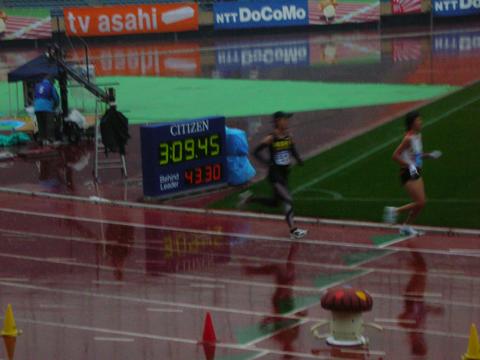
I cheer on a seemingly endless stream of remarkably festive, smiling runners (at least during the first half of the race).   I jump in with Taro Agui who is pacing his Harrier team to a 6-hour finish.  This time may not sound impressive to some of the more elitist readers of this blog, but it is faster than more than half the finishers.    I see my archrival from Ome, Mike Taratko who finishes 541st in 3:29:55.

Perhaps what amazes me most is that the runners from Japan are doing the race on almost zero sleep.  The marathon starts at 5am in Honolulu which is midnight in Japan.  Talk about jet lag.  I have been pondering various triathlons in the US, but  early to mid-morning is the worst time for me to overcome the 5-11 hour time zone difference.  Several of my Tokyo teammates have complained of feeling tired at the start of North American marathons (Anthony in Portland, Carol in NYC), and I am convinced jet lag is a big factor.   Moreover, most of the Japan participants at Honolulu arrive on package tour red-eye flights on Friday morning meaning they are lucky to get one real night of sleep in the 72 hours leading up to the race.  My friend Akiba-san, in the fashion of the typical Japanese salaryman, had been working 20-hour days in the week leading up to the trip, so he was in a sleep deficit even before getting on the flight to Honolulu.   Amazingly he was able to finish in 5 hours. 

The other Honolulu Marathon challenge is that after the sun begins to rise at 6:30am it becomes hotter and hotter, and the participants who take 9 hours to finish find themselves being cooked in midday heat.   But Sunday is such a cool morning that I am inclined to jump in the race myself. 

Would I do this event next year?  The Naha Marathon in Okinawa which is a week earlier provides a tropical vacation and avoids the jetlag and much of the heat (teammate Hideo reports average race temperatures in Naha of only 20 degrees).   Moreover Okinawa is more affordable - the price of everything in Hawaii has risen far beyond my meager budget with many accommodations costing 4 times the local rates I payed a decade ago.


Saturday, November 25, 2006

Autumn 2006: Long hilly runs series


I do not have an elaborate or scientific or difficult marathon training program filled with self-sacrifice. My philosophy now is to find one interesting and enjoyable course each week for the crucial weekly long run.

Fortunately my desire for interesting new runs dovetails with the general expert advice that weekly long run on varied terrain is a key building block in the weeks from 15 weeks to 5 weeks prior to the marathon. Here is Joe Friel in Fast Marathoner:

1. Long runs. Before you can train for speed you've got to first be able to go the distance. I call a "long run" for the marathon one that is two-and-a-half to three hours in duration. Start from your longest run now and add 15 to 20 minutes each time you do one of these. The pace is slow – at least two minutes per mile slower than your 10k pace. 2. Hilly run. Besides the long run, this is the most valuable workout you can do early in the season. These will give you not only strength for hills on the marathon course, but also a more powerful stride.

Here is a list to date of my effort to find various long runs:

Week 1 (Oct 20) The Akasaka Yasukuni Palace Loop - 14k
Painful slog with Darshaun. It is clear from this run that I have a long way to go. 14k isn't really a long run, but it seems extremely long on this day.

Week 2 (Oct 28) The Tamagawa River stroll - 18k
Flat run along the river with Paddy, Juergen, Chris and Ingle. At least socializing takes my mind off the fact that I am out of shape.

Week 3 (Nov 4) The Takao to Fujino Mountain Climb - 24k
Grueling hill run with Terry, Keren, Motozo, Rie, Chika. This scenic point-to-point course starts with 4-5k of town running out of Takao, followed by switchbacks up to the Takao trail. The final section from Jimba Mountain to the small village of Fujino is great running. In Fujino, Keren Motozo and I inhale a lunch of ramen noodles in less than 4-minutes and catch the train back to Tokyo for yoga.

Week 4 (Nov 10) The Higashi Agano Trail Run - 20k
Steep climb and run along ridge in Saitama. Some of the steep sections are unrunnable, but it is enjoyable to explore an interesting new point-to-point course situated an hour out of central Tokyo.

Week 5 (Nov 18) The Kamakura Trail & Beach Run - 24k
My friend Martin who works for the State Department in Afghanistan visits Tokyo for a week and wishes to run the Kamakura loop course. This works perfectly with 17 Nambanners joining us for a long run. The first 12k is on hilly trails and the last half of the course follows the waterfront (2:45 minutes of running, 3:30 of total time with stops for pictures, temples, views, bathroom breaks etc).

Week 6 (Nov 25) The Ome Trail Run
- 25k
Perfect blue skies and spectacular autumn leaves as Chris, Fabrizio, Gary and I cover the hilly trails of Ome, 90-minutes from Roppongi (2:40 minutes)

Friday, November 24, 2006

Red Wine Ingredient Increases Endurance, Study Shows


So apparently I need to break out all the Yellow Tail shiraz that has been sitting on my shelf. The latest research shows that drinking red wine will help my marathon time, or at least increase my endurance on a treadmill if consumed in massive amounts (see below). I always wondered about my teammate's Colin and Bob's success in endurance events -- I assumed it was due to training, but now I realize it is the red wine:


November 17, 2006

Red Wine Ingredient Increases Endurance, Study Shows

A drug already shown to reverse the effects of obesity in mice and make them live longer has now been shown to increase their endurance as well.

An ordinary laboratory mouse will run one kilometer on a treadmill before collapsing from exhaustion. But mice given resveratrol, a minor component of red wine and other foods, run twice as far. They also have energy-charged muscles and a reduced heart rate, just as trained athletes do, according to an article published online in Cell by Johan Auwerx and colleagues at the Institute of Genetics and Molecular and Cellular Biology in Illkirch, France.

"Resveratrol makes you look like a trained athlete without the training," Dr. Auwerx (pronounced OH-wer-ix) said in an interview.

He and his colleagues said the same mechanism seemed likely to operate in humans, based on analysis in a group of Finnish subjects of the gene that is influenced by the drug.

Their rationale for testing resveratrol was evidence obtained three years ago that it could initiate a genetic mechanism known to protect mice against the degenerative diseases of aging and prolong their life spans by 30 percent.

A drug that prolongs life, averts degenerative disease and makes one into a champion athlete sounds almost too good to be true, especially if all or even some of its properties should turn out to apply to people.

Dr. Christoph Westphal, Sirtris's chief executive, replied to this objection with a question, "Is it too good to be true that when you are young you get no disease?"

Dr. Westphal said he believed that the activation of sirtuins was what kept the body healthy in youth, but that these enzymes became less powerful with age. This is the process that is reversed by resveratrol and, he hopes, by the more powerful sirtuin activator drugs that his company has developed, though many years of clinical trials will be needed to prove they work and are safe.

The buzz over sirtuin activators has infected scientists who do research on the aging process, several of whom are already taking resveratrol. Dr. Sinclair has been swallowing resveratrol capsules for three years and has said his parents and half the members of his laboratory do the same. So does Dr. Tomas Prolla at the University of Wisconsin, who said, "The fact that investigators in the field are taking it is a good sign there is something there."

But many others, including Dr. Leonard Guarente of M.I.T., whose 15-year study of sirtuins has laid the basis for the field, say it is premature to take the drug.

Monday, November 20, 2006

Tokyo Elite Marathon Cutoff Bus


Four of my teammates are among the several hundred women to qualify for the prestigious Tokyo Ladies Marathon yesterday, and I joined the throngs lining the course to cheer them on. Japan is a rabid marathon culture and thousands of people stand for hours in freezing rain to see the runners pass by twice on the out-and-back course. Tokyo weather is usually quite benign in November, and the cold temperatures come as a shock after the mild autumn. While us spectators are mildly uncomfortable, the marathon runners endure steadily increasing rain and then a terribly unkind headwind and uphill climb on the return stretch.

I watch the marathon at the 30k mark and most all of the runners faces are contorted with pain as they stare ahead toward the heartbreak hill. But the really frightening thing is looming behind them. The bitterly cruel fact of this elite marathon is that if the runners fail to maintain a fast 3:30:00 finishing time pace through various cutoff points, the race officials will pull them off the course and deposit them on the sweeper buses trailing the field. After months of training and 40-kilometers of pain, they could be pulled off the course and denied the chance to finish the event! Runner after runner passes me each looking more nervous. Three of my Namban teammates pass safely, though Mika K does not have a large cushion over the cutoff time. Then in the distance I see them. It is an ominous sight, worse than any horror movie, the buses bearing down with their lights piercing the rain drops.

An advance official in a car tries to persuade the last woman to stop running and get on the bus, but she gamely presses on despite the apparent futility of beating the time at the next cutoff mark.

Then I watch the bus pass. The bus is filled with wet and exhausted and disheveled runners swaddled in huge blankets. They are paraded slowly along the race course, all of them staring downward, eyes averted from the crowd, looking far more sad and forlorn than if they were a group of prisoners being taken away to a guillotine to be executed.

I am outraged and ready to organize a loud protest of this horribly merciless practice of cutting runners off, but then when I ask the participants what they think of this heartless standard, they shrug it off an integral aspect of the event. It is the tough standard that make it a truly "elite" event wherever finisher can stand shoulder to shoulder with the Olympic Gold medal winner. The harsh cutoff makes the accomplishment of finishing that much sweeter.

Tuesday, November 14, 2006

Everything You Know About Marathons Is Wrong

I just found out that everything I know about marathons is wrong.  According to the article (pasted below) a study of data from several decades of marathons showed -

1.  The slowing effect of heat is not as great as people think.  A runner who finished in 3-hours on a 41-degrees F (5 degrees C) day, would be slowed by 12% to 3 hours and 21 minutes in 77-degree (25 degrees C) weather.   Wow - that is a huge difference to me - the difference between a good and bad marathon.   Then it stands to reason that if I add in the effect of running in humid conditions versus the dry conditions in the US, the effect of heat will be greater.  Moreover, I am convinced that I am "atsugari" (heat has a greater weakening effect on me than the average person).  So I am more convinced than ever that I should seek out cool weather triathlons and marathons.  And avoid the packs of runners generating all that heat.  And be happy when the race day is sunny. 

2. Cramping is caused by dehydration and lack of salt  - I guess I might as well throw out those salt tablets.  The cramps during the Sado Triathlon run brought me to a stop.   When I was in a catatonic state at the end of Sado they dragged me off to a big salt bath by the medical tent.  I guess this was not the optimal solution.  Hmmm.  The salt baths felt pretty good..


NY Times

Everything You Know About Marathons Is Wrong

Most runners have heard the marathon lore: Your time will be best if the weather on race day is about 55 degrees and overcast, or even drizzly. And avoid dehydration at all costs, because it will cause your muscles to cramp and you could collapse at the finish line.

But none of that is true, researchers said at a recent marathon medicine and science conference in Chicago.

The weather theory "needs adjusting," said Scott J. Montain, a research physiologist at the United States Army Research Institute of Environmental Medicine in Natick, Mass.

"Most of what we know comes from the lay literature," he said.

Thousands of runners are no doubt monitoring the weather forecast for Sunday, when the New York City Marathon makes its annual tour of the five boroughs. (As of yesterday, it looked promising, with temperatures expected to be in the upper 40's and partially cloudy skies.) But the weather nostrums for marathoning that are cited so authoritatively in journal articles and textbooks are not always borne out in legitimate science. Montain and his colleagues set out to conduct a proper study.

They gathered data from 28 years of the New York City Marathon, 35 years of the Boston Marathon and 23 years of the marathons in Hartford, Vancouver, Duluth, Minn., and Richmond, Va. The routes for those marathons have barely changed over the years, and each had a large field — more than 10,000 runners. The investigators looked at the average times for the top three men and women, and at the times for the runners who placed 25th, 50th, 100th and 300th.

Elite runners ran fastest in the coldest conditions — 41 to 50 degrees. But the slowing effect with heat was not as great as had been previously reported. For every five-degree increase in temperature, times slowed by 0.4 percent.

Warmer weather had a greater effect on slower runners. On a 77-degree day, an elite runner would be about 5 percent slower than on a 41-degree day. But a runner who finished in three hours on a 41-degree day would be slowed by about 12 percent on a 77-degree day, finishing in 3 hours 21 minutes.

One reason, Montain said, could be that slower runners spend more time on the course, and the temperature generally rises through the day. Or it could be because slower runners tend to run with a larger pack. A tightly clustered group of runners generates heat and blocks it from dissipating.

Montain and his colleagues also looked at whether marathon times were better under sunny or overcast skies. Only 13 percent of records were set on cool and cloudy days.

"It is more likely that a record will be set when it is sunny or when there are scattered clouds," Montain said. He is not sure why that is; perhaps sunny conditions put runners in a better mood, he suggested.

Then there is the issue of cramping, that often excruciating, spasmodic, involuntary contraction of muscles that can occur during or, more often, just after a marathon. It almost always involves the muscles that were used to run — the hamstrings or calf muscles, for example. And it can last a minute or two — or much longer.

Conventional wisdom says cramps are caused by dehydration and that the solution is to consume salt and drink more fluids. Not true, says Martin P. Schwellnus, a professor of sports medicine at the University of Cape Town in South Africa.

At the conference in Chicago last month, he reported that he could find no relationship between dehydration and cramping. He has studied cyclists, marathoners and triathletes, measuring levels of electrolytes and body-weight changes, both of which are indicators of dehydration. Those who cramped were no different from those who did not.

Two other studies looked at how much weight ultramarathon runners and triathletes lost during races — a measure of fluid loss and a direct indicator of dehydration. Those who cramped lost no more weight than those who did not. If anything, Schwellnus said, those who did not have cramps were slightly more dehydrated.

The cause of cramps, Schwellnus believes, is an alteration in the electrical signals going to exhausted muscles so that the balance between those signals activating muscles and those inhibiting them is distorted. One way to protect yourself is with proper marathon training and proper pacing. "Racing at too high of an intensity is one of the single most important risk factors," Schwellnus said.

When muscles cramp, there is a simple and effective treatment: stop running and stretch that muscle. And, Schwellnus said, realize that the cramping will soon stop.

"Almost no matter what you do, if you stop the activity, the muscle will come back to normal," he said.

Beyond the finish line of every marathon are runners who feel dizzy, and some of them collapse. It is not as common as muscle cramps, but the condition can afflict up to about 5 percent of marathon runners, said Michael N. Sawka, head of the thermal and mountain medicine division at the United States Army Research Institute of Environmental Medicine. He wondered whether the cause could be dehydration, a commonly evoked mechanism.

Sawka looked at published studies. One compared 45 athletes who collapsed after an ultramarathon to 65 who completed the race and did not collapse. There were no obvious differences between the two groups: their body temperatures were the same (dehydration makes the temperature rise), as were their electrolyte levels. But those who collapsed were pushing themselves as hard as they could, were at or close to their personal records, or were medal winners in the race. Perhaps, Sawka said, "that final effort might contribute to collapse."

The actual cause, though, does not appear to be dehydration, Sawka said. Instead, it is a pooling of blood in the lower legs and feet when vigorous exercise suddenly stops and the heart rate slows markedly.

Timothy Noakes, a professor of exercise and sports science at the University of Cape Town, said he had stopped giving intravenous fluids to collapsed runners.

"We completely changed the way we treat patients," Noakes said. "All we do is have them lie down and put their feet higher than their head."

Postmarathon collapse, Noakes added, "is a benign condition."

"Just lift their legs and you will help the majority of patients," he said. "That's all you need to do to make most people recover very, very quickly. You can infuse as much fluid as you want, and you will not get the same response."


Monday, November 13, 2006

Tokyo Marathon in 14 weeks


My autumn 2006 objective is to stop the downward spiral of my running career.  The triathlon training is not carrying me.  A week ago Wednesday I struggled to maintain 3:25 pace for the monthly 6 x1000 interval training.   My teammates were shocked and dismayed.   "Jay, you are a shell of your former self" they all said. 

I entered the Tokyo Marathon on February 18, so I need to regain at least some minimum level of fitness.

Presumably my struggles are a result of the low mileage I mentioned in my Edogawa Report Blog.  Since the second week of October I have begun to pickup my training a bit.  Here is my weekly mileage (in kilometers) since the Sado Triathlon:

Sept  4-9        17
Sept 10-16     18
Sept 17-23     33
Sept 24-30     18
Oct  1 - 7       14
Oct  8 -14      35
Oct 15-21      38
Oct 22-28      43
Oct 29-4        49
Nov 5-11        43

Monday, October 23, 2006

Edogawa 10k


Yesterday's Edogawa 10k served as a wake-up call for me. It is apparent now that running two days per week is not adequate training to maintain my competitive racing level. For the past 3-4 months I have been doing a solid interval running workout every Wednesday night, but the rest of the week I am focused on swimming, cycling, and yoga. I assumed other run workouts will somehow materialize, but invariably what has happened is that each week I only end up squeezing in one additional garbage run - usually 8-9k around the Palace with a friend at a slow pace (see blog entry from October 7).


Prior to yesterday's 10k I knew I was in trouble (my Wednesday track times have been slipping by 5-10 seconds per kilometer). I ran the first kilometer of Sunday's race at 3:45, then attempted to increase the speed a bit. I hit the halfway mark at 18:27 at which point I could feel myself weakening. Somehow I managed to maintain a 3:40 pace for the next few kilometers.


The real shock came at the 9k mark when the course takes a U-turn and suddenly I spotted Namban teammate Bob Poulson right behind me. You have to realize that Bob is old -- very, very old. I am not even sure how old Bob is - when I joined the club I was told that Bob had originally come to Japan on Admiral Perry's Black Ships which would make him well over 100 years old.. Later I was told that Bob came to Japan even earlier than that -- walking across to Japan from Siberia during the last Ice Age when the oceans had retreated. These stories may be exaggerated, but in any case, Bob is much older than me.

So of course I pushed my legs as best I could over the last kilometer in order to stay ahead of the ancient one, and I managed to finish in 37:09 (slower than my half-marathon pace a year ago).

Now after all this seemingly negative talk, I should point out that I perceive the glass as being more than half full. The Edogawa event was a fine day. 25 teammates participated, 7 of them achieving personal bests. Everyone seemed to have a good time and I was glad to have played a small role in promoting the event. Moreover I managed to finish 8th in my age division and it was gratifying that I could be in the award ceremony at all given my low mileage training. (The Edogawa 10k award ceremony is a remarkable event in itself with the pageantry and ritual one would expect at the crowning of a new Roman Catholic Pope or Olympic opening ceremony).


Clearly cross-training allows me to maintain overall fitness. I know from past experience if I had not been doing the swimming and biking these past few months (or did nothing for more than 3 weeks) I would have been light years farther back.

Friday, October 13, 2006

Visit to Nike World HQ

I like to consider myself a loyal and devoted Asics person. But yesterday I found myself at Death Star, the Nike World Campus in Beaverton Oregon.

Years ago, when I was growing up in nearby Seattle and Nike was a small renegade company I was the company's biggest fan, and wore the original Pegasus, Equator, Cortez, and Waffle racer. But over the years the company's emphasis on marketing over product development, the ubiquity of the produce (12 million shoes sold last year in Japan alone), and the general arrogance of the Nike brand image has turned me anti-Nike. Especially after learning how Nike got its start by stealing Asic's product design, patenting the design in the US, and then turning around and filing a lawsuit against Asics.

Despite these strong feelings, I am willing to sell out on my beliefs at a cheap price -- 50% employee discount on the new Nike Air Equalon at the Nike Employee Store.

I must admit the Equalon's feel pretty good. I went for a test run around the Nike campus. The Nike campus is a pretty competitive corporate jogging trail. I was running at a reasonably good pace, but two female MBA-type marketing staff overtook me by the Alberto Salazar building.

The Nike workplace is amazing with a soft woodchip running trail meandering around the 178 acre site. The campus has an artificial lake at its center surrounded by buildings named after Nike athletes like Lance Armstrong, Mia Hamm etc. At the entrance is a museum with Steve Prefontaine's old shoes and jersey.

Of course I hope to get Ascis (or if necessary Saucony or Adidas) for my next racing flats.

Saturday, October 07, 2006

Minimalist Run Training - Running two days per week


Thousands of runners (mostly lazy Americans) have completed a marathon based on a training regime of only three runs per week.   The serious runners in my Tokyo running team are appalled to hear of such half-hearted devotion to the sport.

As I start preparing for the fall race campaign I am doing even less than that.  Over the past several months my run training is down to only TWO workouts per week. 

Here is my recent weekly mileage (in kilometers, not miles)

July 30 - 8/5   - 26
Aug 6 -12      -  31
Aug 13-19     -  34
Aug 20-26     -  29   
Aug 27 -9/2   -  19    (Sado taper)
Sept 3-9       -   37   (Sado Triathlon)
Sept 10-16   -   17
Sept 17-23   -   28
Sept 24-30   -   18

Granted each week I am also doing 2-3 one-hour swim sessions and 1-3 bike rides/spin sessions.  This cross-training has so far allowed me to maintain a reasonably competitive level of speed and endurance . 
 
However as I struggled to run 6 x 1000 meters on Wednesday at a 3:22 average, I begun to wonder if the limited running is starting to have a negative impact on me.